Assets vs Liabilities: How They Affect Your Wealth and Net Worth
Tags: Beginners, Cash Flow, Debt Management, Investing, Loan Repayment, Long-Term Investing, Long-Term Wealth, Net Worth, Property Appreciation, Property Investment, Real Estate Investment, Real Estate Leverage, Wealth Accumulation, Wealth Building, Wealth Creation, Wealth Management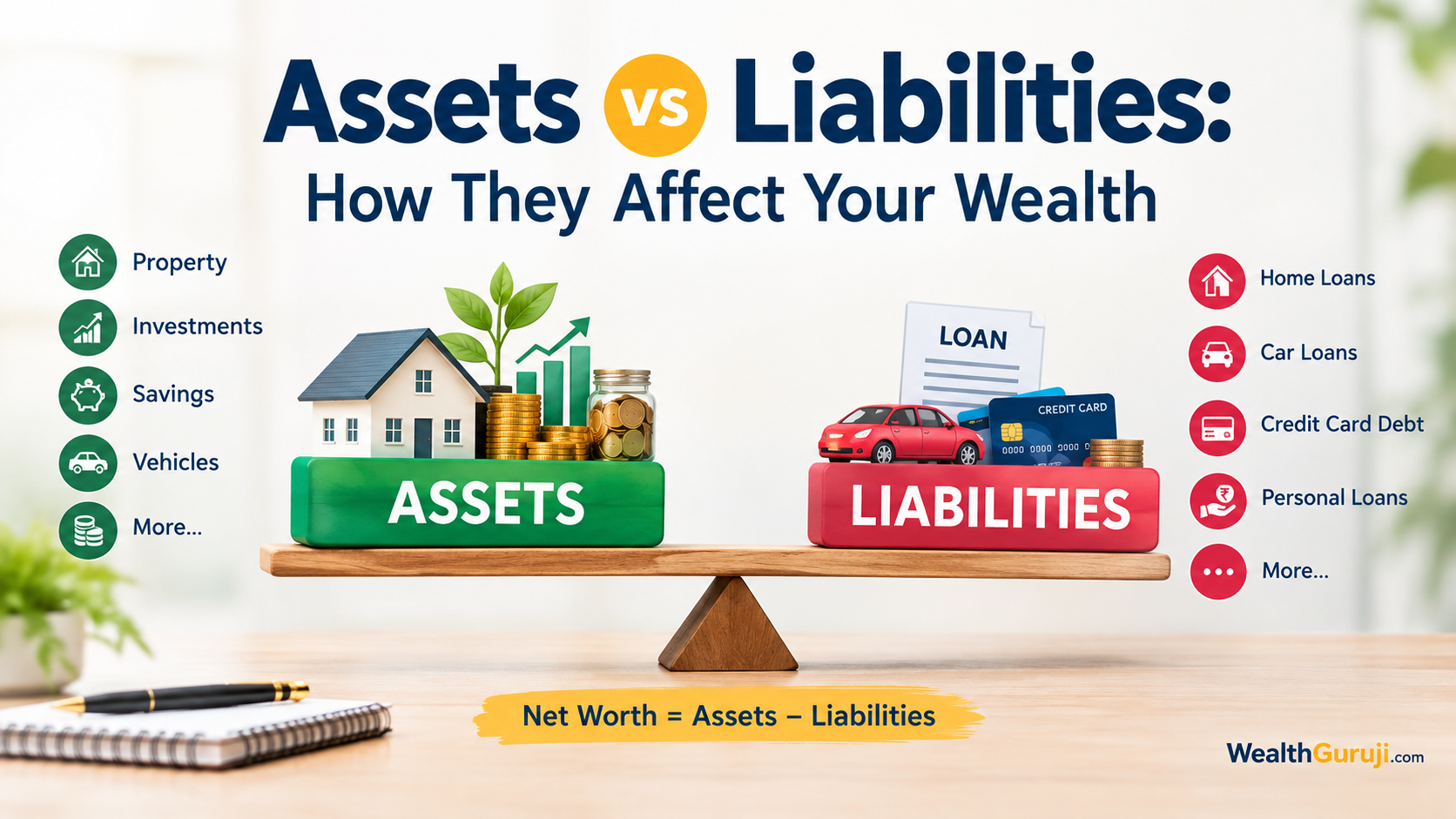
Building wealth is not only about earning more money. It is also about what you own, what you owe, and how the two change over time.
A person may have a high salary but still have limited wealth if most of the income goes toward EMIs, credit-card bills, vehicle loans and lifestyle expenses. On the other hand, someone with a more modest income can gradually build wealth by saving regularly, investing in productive assets and keeping liabilities under control.
This is why understanding assets vs liabilities is an important part of personal finance.
In simple terms, assets are things you own that have financial value, while liabilities are amounts you owe to others. Your net worth is the difference between the two.
In this article, we will look at the difference between assets and liabilities, understand productive and depreciating assets, and see how property, investments, vehicles and loans can affect your long-term wealth.
What Is an Asset?
An asset is something you own that has financial or economic value.
Common personal assets include:
- Bank savings
- Fixed deposits
- Stocks and mutual funds
- Gold
- Residential or commercial property
- Land
- Retirement savings
- Business ownership
- Vehicles and other valuable personal property
However, there is an important point to understand:
Not every asset helps build wealth in the same way.
A mutual fund investment may have the potential to grow over time. A rental property may generate income and appreciate. A car has value, but it usually loses value as it gets older and also requires fuel, insurance, maintenance and repairs.
So, when building wealth, it is useful to think beyond simply owning assets.
The better question is:
Does this asset help improve my financial position over time?
What Is a Liability?
A liability is an amount that you owe and are required to repay.
Examples include:
- Home loans
- Personal loans
- Car loans
- Credit-card outstanding balances
- Education loans
- Business loans
- Consumer finance
- Other forms of borrowed money
Liabilities are not automatically bad.
A home loan used to purchase a property that fits your budget can help you acquire a long-term asset. Similarly, a business loan may help a profitable business expand.
The problem usually begins when debt becomes too large, too expensive or is used for things that do not improve your financial position.
Assets vs Liabilities: The Basic Difference
| Assets | Liabilities |
|---|---|
| Things you own | Money you owe |
| Have financial value | Create financial obligations |
| Can potentially generate income or appreciate | Usually require repayment |
| Examples: investments, property, savings | Examples: loans, credit-card debt |
| Increase your net worth when they exceed related debt | Reduce your net worth |
A simple way to understand your financial position is:
Net Worth = Total Assets − Total Liabilities
For example, suppose you own:
- Home worth: ₹60 lakh
- Investments: ₹10 lakh
- Bank savings: ₹5 lakh
- Car: ₹5 lakh
Your total assets are ₹80 lakh.
Now suppose you have:
- Home loan outstanding: ₹35 lakh
- Car loan outstanding: ₹3 lakh
- Credit-card debt: ₹2 lakh
Your total liabilities are ₹40 lakh.
Therefore:
Net Worth = ₹80 lakh − ₹40 lakh = ₹40 lakh
Tracking this number over time can give you a clearer picture of whether your wealth is actually growing. FINRA also recommends periodically calculating net worth by adding assets and subtracting liabilities.
Productive Assets vs Depreciating Assets
One of the most useful concepts in wealth building is the difference between an asset that works for you and an asset that mainly costs you money to own.
Productive Assets
Productive assets can potentially generate income, increase in value, or both.
Examples include:
- Equity investments
- Mutual funds
- Bonds and other investments
- Rental property
- A profitable business
- Certain income-generating land or commercial assets
SEBI’s investor education material covers several investment asset classes, including equities, bonds, mutual funds, real estate and precious metals. It also notes that different asset classes have different risks and liquidity characteristics.
For example, a rental property may generate rent while also potentially appreciating over the long term.
An investment portfolio may generate returns through capital appreciation, dividends or interest, depending on the investments selected.
Depreciating or Costly Assets
Some assets have value but may not contribute positively to wealth over time.
A common example is a personal car.
Suppose you buy a car for ₹10 lakh. After several years, its resale value may be considerably lower. At the same time, you have paid for:
- Fuel
- Insurance
- Maintenance
- Repairs
- Parking
- Interest, if financed
The car is still an asset because it has resale value. But it may not be a productive wealth-building asset.
This distinction is important.
An asset on your balance sheet is not necessarily an asset that grows your wealth.
Is a Home an Asset or a Liability?
This is one of the most common areas of confusion.
The house is an asset.
The home loan is a liability.
Suppose you buy a house worth ₹70 lakh and have an outstanding home loan of ₹45 lakh.
Your property may be worth ₹70 lakh, but the entire ₹70 lakh is not your equity.
Your approximate equity is:
₹70 lakh − ₹45 lakh = ₹25 lakh
As you repay the principal, the outstanding loan can reduce. If the property’s value also increases, your equity may grow further.
However, home ownership also comes with costs such as maintenance, taxes, insurance, repairs and financing costs.
A property should therefore be evaluated as a complete financial decision rather than simply assuming that owning property automatically creates wealth.
WealthGuruji’s financial wealth-building strategy using real estate explains how rental income, property appreciation, loan repayment and equity can work together while also highlighting the costs and risks involved.
Are Loans Always Bad for Wealth?
No.
Debt can be useful when it is used carefully and the asset or activity supported by the borrowing contributes to your financial goals.
Consider two situations.
Example 1: Home Loan
You borrow ₹40 lakh to purchase a property that fits your budget.
The property may:
- Provide a place to live
- Potentially appreciate
- Build equity as the loan is repaid
The loan is still a liability, but it is connected to an asset.
Example 2: Consumer Debt
Now imagine borrowing ₹2 lakh to buy expensive electronics, a luxury holiday and other items that have little long-term financial value.
You still have to repay the ₹2 lakh, plus interest and other applicable charges.
The purchases may provide immediate enjoyment, but they do not necessarily create an asset that helps build long-term wealth.
This is why the purpose, cost and size of debt matter.
Why High-Cost Debt Can Slow Wealth Creation
Interest can make liabilities grow expensive.
When you borrow money, part of your future income has already been committed to repayment. That reduces the money available for saving, investing and other financial goals.
FINRA notes that reducing excessive high-interest debt can strengthen a person’s financial foundation, while interest costs can make the debt more expensive than many people realise.
Before taking a loan, do not look only at the EMI.
Also check:
- Interest rate
- Loan tenure
- Total interest payable
- Processing and other charges
- Prepayment conditions
- Penal charges, where applicable
- Your existing EMIs
- Your ability to handle the repayment if income changes
A smaller EMI is not always a cheaper loan. A long tenure can reduce the monthly payment while increasing the total interest paid.
How Investments Can Turn Savings Into Wealth
Money sitting in a savings account has value, but long-term wealth generally requires some of your money to be invested appropriately for your goals.
Investment options can include:
- Equity
- Mutual funds
- Bonds and fixed-income investments
- Retirement-oriented investments
- Real estate
- Gold
- Other suitable financial assets
SEBI highlights the importance of choosing investments based on financial goals, risk appetite and investment horizon. It also explains that diversification can spread investment exposure across different assets and investments.
Investor.gov similarly explains that asset allocation and diversification involve spreading investments across different asset classes and investments to manage risk.
This does not mean every investment will rise in value.
All investments carry some level of risk.
The objective is to build a sensible mix of assets that fits your financial goals rather than putting all your money into one investment.
A Car Can Be an Asset and Still Reduce Wealth
This example makes the difference especially clear.
Suppose two people each buy a ₹12 lakh car.
Person A
The car is financed with a large loan. The person also spends heavily on accessories and upgrades.
The vehicle depreciates, while the owner pays:
- EMI
- Interest
- Insurance
- Maintenance
- Fuel
The car becomes a significant monthly financial commitment.
Person B
The second person buys a reasonably priced vehicle using savings and chooses a model with manageable running costs.
The vehicle still depreciates, but the financial burden is lower.
Both people own an asset.
But the effect on their wealth can be very different.
The goal is not to avoid every depreciating asset. The goal is to prevent lifestyle assets from consuming the money that could have been invested in productive assets.
Consumer Debt Can Quietly Reduce Wealth
Credit cards and consumer loans can be convenient, but they can become a problem when used for spending that is not supported by income or savings.
For example, buying a ₹1 lakh item with borrowed money means you are using future income to pay for today’s purchase.
If the balance remains outstanding and interest or other charges accumulate, the actual cost can become much higher than the original purchase price.
This is why a useful personal-finance habit is:
Before buying something on credit, ask whether you are acquiring value or simply creating another liability.
How to Move From More Liabilities to More Assets
You do not need a complicated financial plan to start improving your asset-liability balance.
1. List Everything You Own
Make a simple list of:
- Savings
- Investments
- Property
- Gold
- Retirement accounts
- Business interests
- Vehicles and other valuable assets
Use realistic current values instead of emotional estimates.
2. List Everything You Owe
Include:
- Home loans
- Vehicle loans
- Personal loans
- Credit-card balances
- Education loans
- Business loans
- Other outstanding debt
3. Calculate Your Net Worth
Use:
Assets − Liabilities = Net Worth
Repeat the calculation periodically.
A growing income is useful, but a steadily improving net worth gives you a clearer indication of whether your financial position is strengthening.
4. Reduce Expensive Debt
Prioritise high-cost debt where appropriate.
Paying down expensive debt can free monthly cash flow for investing and other goals.
5. Build Productive Assets
As your financial position improves, direct more savings toward assets that can potentially:
- Grow in value
- Generate income
- Build long-term financial security
6. Avoid Unnecessary Lifestyle Debt
A bigger house, newer car or expensive lifestyle may look attractive, but taking on large liabilities simply to maintain a lifestyle can slow wealth creation.
The aim is not to stop spending.
The aim is to spend without damaging your long-term financial position.
A Simple Asset-Building Example
Consider an individual with an annual income of ₹12 lakh.
Initially, most of the surplus is used for lifestyle expenses and loan repayments.
Over time, the person changes the approach:
Income → Expenses → Savings → Investments → Productive Assets → Growing Net Worth
Suppose the person begins building:
- An emergency fund
- Mutual fund investments
- Retirement savings
- Gold as one part of diversification
- A suitable property over time
At the same time, the person avoids unnecessary personal loans and reduces credit-card debt.
The transformation does not happen in one year.
But over 10 or 15 years, the difference between consuming income and turning surplus income into assets can become significant.
WealthGuruji’s broader financial wealth-building strategy also focuses on increasing income, controlling expenses, managing debt and investing for long-term wealth.
Can Gold Be Considered an Asset?
Yes. Gold is an asset, but it should be understood correctly.
Physical gold can have financial value and may serve as part of a diversified portfolio. However, gold prices can rise and fall, and physical gold also involves considerations such as purity, storage and transaction costs.
SEBI includes precious metals among recognised investment asset classes, while WealthGuruji’s financial wealth-building strategy using physical gold discusses gold as one possible component of a broader wealth strategy rather than a complete wealth-building plan.
The important point is that diversification matters. Investor.gov notes that spreading investments across assets can help manage portfolio risk, although diversification cannot eliminate investment losses.
Five Questions to Ask Before Taking on a New Liability
Before taking a loan or buying something on credit, ask:
- Do I really need it?
- Will this purchase improve my financial position or mainly increase my expenses?
- What is the total cost, including interest and charges?
- Can I comfortably repay the debt even if my income falls temporarily?
- Will this liability prevent me from investing for important long-term goals?
These five questions can prevent many unnecessary financial commitments.
Key Takeaways
- Assets are things you own; liabilities are amounts you owe.
- Net worth = assets − liabilities.
- Not every asset is a productive wealth-building asset.
- Property can be an asset, while the home loan secured against it is a liability.
- A car is an asset but may depreciate and create significant ongoing costs.
- Investments can help convert savings into long-term wealth, but they always involve risk.
- High-cost consumer debt can reduce the amount available for savings and investing.
- A manageable loan used for a sensible purpose can be different from expensive debt used for consumption.
- Tracking your net worth regularly can show whether your financial position is improving.
- The long-term objective should be to gradually increase productive assets while keeping liabilities under control.
Conclusion: Build More Assets Than Liabilities
Wealth building becomes easier to understand when you look at your personal finances through two simple questions:
What do I own?
What do I owe?
The difference between the two is your net worth.
A person does not necessarily become wealthy by earning a high income or owning many things. Long-term wealth is more closely connected to the ability to save money, acquire productive assets, manage debt and allow those assets to grow over time.
The next time you consider buying a property, vehicle, investment or any expensive item, look beyond the purchase price.
Ask how it will affect your assets, liabilities, cash flow and net worth.
That simple habit can make your financial decisions much clearer.
Frequently Asked Questions
What is the difference between assets and liabilities?
Assets are things you own that have financial value, while liabilities are amounts you owe. Your net worth is calculated by subtracting total liabilities from total assets.
Is a home an asset or a liability?
The home itself is an asset. A home loan taken to purchase the property is a liability. Your actual equity in the property is broadly the property’s value minus the outstanding loan.
Is a car an asset or a liability?
A car is an asset because it has resale value. However, it can be a depreciating asset and may also create costs such as fuel, insurance, maintenance and loan interest.
Are all debts bad for wealth building?
No. Debt can sometimes help acquire an asset or fund a productive activity. The important factors are the purpose of the borrowing, interest cost, repayment capacity and the effect of the debt on your overall financial position.
How can I increase assets and reduce liabilities?
Build savings, invest according to your goals, reduce expensive debt, avoid unnecessary consumer borrowing and review your net worth regularly.
Why is net worth more useful than income for measuring wealth?
Income tells you how much money you earn. Net worth shows what you own after subtracting what you owe. Someone can have a high income but low net worth if their liabilities and spending are also high.
Are investments always productive assets?
Not necessarily. An investment can lose value or produce poor returns. Productive assets are generally those that can potentially generate income or increase in value, but no investment outcome is guaranteed.
How often should I calculate my net worth?
Calculating it once or twice a year can be a practical habit. The important thing is to use reasonably accurate values and compare the trend over time.