Wealth vs Income: What Is the Difference?
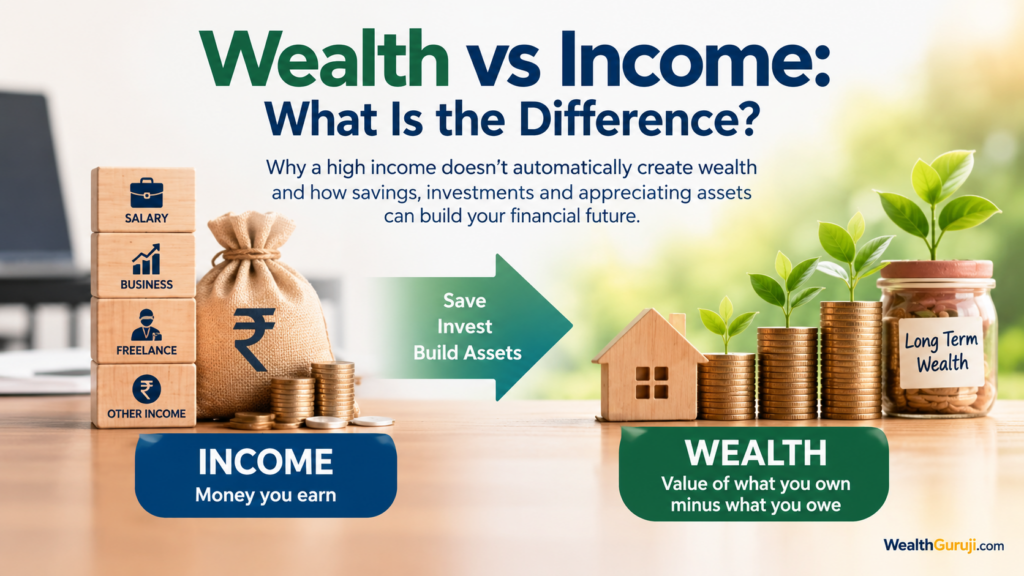
Wealth vs Income Build Your Future
Many people believe that a high salary automatically means they are wealthy. But income and wealth are not the same thing.
A person earning ₹2 lakh a month can have very little wealth if most of the money is spent on lifestyle expenses, EMIs and other commitments. At the same time, someone earning ₹75,000 a month may gradually build significant wealth by saving regularly, investing wisely and accumulating valuable assets.
The basic difference is simple:
Income is the money you earn. Wealth is the value of what you own after subtracting what you owe.
Understanding this difference can completely change the way you think about money.
In this article, we will explain the difference between income and wealth, why a high income does not automatically create financial wealth, and how savings, investments and assets can help turn income into long-term wealth.
What Is Income?
Income is the money you receive from your work, business or investments.
For an individual, income may come from:
- Salary
- Business profits
- Freelance work
- Professional fees
- Rental income
- Interest income
- Dividends
- Other sources of earnings
For example, suppose your monthly salary is ₹1,00,000.
Your annual salary before considering taxes and other deductions is ₹12 lakh.
That ₹12 lakh is your income.
Income tells you how much money is coming into your financial life. It does not tell you how much you own.
What Is Wealth?
Wealth is a measure of your overall financial position.
A simple way to calculate net worth is:
Net Worth = Total Assets − Total Liabilities
Your assets may include:
- Bank savings
- Fixed deposits
- Mutual funds
- Shares
- Gold
- Property
- Retirement savings
- Business interests
- Other investments
Your liabilities may include:
- Home loan
- Car loan
- Personal loan
- Credit card dues
- Other outstanding debt
For example:
| Financial Position | Amount |
|---|---|
| Savings and investments | ₹15 lakh |
| Property value | ₹50 lakh |
| Gold and other assets | ₹5 lakh |
| Total assets | ₹70 lakh |
| Home loan | ₹30 lakh |
| Other loans | ₹5 lakh |
| Total liabilities | ₹35 lakh |
| Net worth | ₹35 lakh |
So, even though the person’s assets are worth ₹70 lakh, their net wealth is ₹35 lakh after accounting for liabilities.
Income vs Wealth: The Key Difference
The easiest way to understand the difference is to think of income as a flow and wealth as a stock.
Income is measured over a period of time, such as monthly or annual earnings.
Wealth is the financial value you have accumulated at a particular point in time.
| Income | Wealth |
|---|---|
| Money you earn | Value of what you own minus what you owe |
| Usually measured monthly or annually | Measured through net worth |
| Comes from salary, business, rent, etc. | Comes from accumulated assets and equity |
| Can increase or decrease quickly | Usually builds gradually |
| Can be spent | Can generate future income or appreciate |
| Does not automatically create wealth | Represents accumulated financial strength |
This is why earning more money and becoming wealthier are related, but they are not the same thing.
Why a High Income Does Not Automatically Create Wealth
A high income gives you more financial capacity. But what you do with that income determines whether it becomes wealth.
1. Higher income can lead to higher spending
When income increases, many people increase their lifestyle as well.
This may include:
- A bigger home
- A more expensive car
- Frequent travel
- Dining out
- Premium gadgets
- Higher subscriptions
- Larger discretionary spending
This is often called lifestyle inflation.
For example, consider two professionals.
Person A earns ₹80,000 per month and spends ₹60,000.
Monthly surplus = ₹20,000
Person B earns ₹2,00,000 per month but spends ₹1,90,000.
Monthly surplus = ₹10,000
Person B has a much higher income, but Person A has a higher monthly amount available for saving and investing.
This is why income alone is not a reliable measure of financial wealth.
2. Debt can reduce wealth
A person may own expensive assets but still have limited net worth because of large liabilities.
For example, someone may own:
- A ₹1 crore house
- A ₹15 lakh car
- Other assets worth ₹10 lakh
But if total outstanding loans are ₹90 lakh, their net worth is much lower than the asset values might suggest.
Debt is not automatically bad. A carefully managed home loan, for example, can help a person acquire an asset.
The important question is whether the debt is manageable and whether it supports rather than damages the overall financial position.
RBI’s financial-literacy material emphasizes saving, prudent borrowing and financial planning as important parts of sound money management.
3. Income stops, but assets can continue working
Salary is usually linked to your work.
If you stop working, your salary may stop.
Assets can be different.
A rental property may generate rental income. Investments may generate interest, dividends or capital appreciation. A business can produce profits without requiring the owner to personally perform every task.
This is one reason long-term wealth building focuses on accumulating productive or valuable assets, rather than simply increasing monthly income.
How Income Turns Into Wealth
The basic wealth-building process can be explained in a simple sequence:
Earn → Save → Invest → Build Assets → Grow Net Worth
Each step matters.
Step 1: Earn
Your income provides the starting point.
Increasing your earning ability through better skills, career growth, business expansion or additional income sources can create more financial capacity.
Step 2: Save
Not all income should be spent.
Savings create the money needed for emergencies, future goals and investments.
RBI’s financial awareness guidance describes saving as setting aside part of income before spending and highlights safety, liquidity and return as important factors when deciding where to keep savings.
Step 3: Invest
Savings sitting idle may not be enough for long-term wealth creation.
Investing allows money to potentially grow over time.
SEBI’s investor education resources explain the importance of investing, compounding, diversification and matching investments with financial goals and risk tolerance.
Step 4: Build Assets
Over time, your savings may become:
- Mutual fund investments
- Shares
- Bonds or fixed-income investments
- Property
- Gold
- Retirement savings
- Business ownership
These assets can contribute to your financial position.
Step 5: Grow Net Worth
As your investments grow, your loans reduce and your assets become more valuable, your net worth can increase.
That is the real transition from earning money to building wealth.
Savings Are Important, But Savings Alone May Not Be Enough
Saving money is the foundation of financial stability.
But long-term wealth creation usually requires more than simply keeping money in a bank account.
Inflation gradually reduces the purchasing power of money. This means that ₹10 lakh saved today will not necessarily buy the same amount of goods and services many years from now.
This is why financial planning often involves a combination of:
Savings + Investing + Asset Growth + Debt Management
SEBI specifically highlights the role of investing and the power of compounding in long-term financial planning.
The Power of Compounding
One of the strongest connections between income and wealth is compounding.
Compounding means that returns earned on an investment can themselves generate further returns over time.
For example, suppose you invest ₹10,000 every month for many years.
You are not only contributing fresh money. Over time, the returns generated by your earlier investments may also contribute to future growth.
The exact result depends on the investment, return, fees, taxes and market conditions. Returns are not guaranteed.
But the principle is important:
Time can make a major difference to wealth creation.
SEBI’s investor education material explains that starting early gives investments more time to benefit from compounding.
Appreciating Assets Can Help Build Wealth
Another important difference between income and wealth is that wealth can grow through asset appreciation.
Suppose you buy an asset for ₹20 lakh and, after several years, its value becomes ₹30 lakh.
The ₹10 lakh increase contributes to your net worth, subject to the asset’s actual market value and any related costs or liabilities.
This can happen with certain investments and assets such as:
- Equity investments
- Real estate
- Business ownership
- Gold
However, appreciation is never guaranteed.
Asset prices can remain flat or decline. Good wealth building therefore involves understanding risk, diversification and the purpose of each investment.
Investor.gov notes that diversification cannot eliminate investment losses, but spreading investments across different assets can reduce dependence on any one investment.
A Simple Example: High Income vs High Wealth
Consider two people.
Rahul: High Income, Low Wealth
Rahul earns ₹2,00,000 a month.
His lifestyle costs ₹1,70,000.
He spends another ₹20,000 on loan repayments and other commitments.
Only ₹10,000 is left for investment.
Although Rahul has a high income, his wealth may grow slowly.
Amit: Moderate Income, Consistent Wealth Building
Amit earns ₹1,00,000 a month.
His total monthly expenses are ₹65,000.
He saves and invests ₹25,000 and keeps ₹10,000 available for other financial priorities.
Over several years, Amit builds investments and assets.
His income is lower than Rahul’s, but he is consistently converting part of his income into wealth.
The lesson is not that a lower income is better.
The real lesson is:
Income creates the opportunity to build wealth. Financial decisions determine how much of that opportunity becomes wealth.
How to Convert More Income Into Wealth
You do not need to become a high-income professional before starting.
You can begin with simple financial habits.
1. Track Your Money
Know:
- Monthly income
- Essential expenses
- Discretionary spending
- EMIs
- Savings
- Investments
- Total debt
You cannot improve what you do not measure.
2. Increase Your Savings Rate
As income rises, try to increase the amount you save and invest instead of allowing every salary increase to become additional lifestyle spending.
For example:
Salary increase → Increase investing → Increase asset ownership
rather than:
Salary increase → Increase lifestyle expenses
3. Create an Emergency Fund
An emergency fund protects your long-term investments from unexpected expenses.
Without adequate cash reserves, a sudden medical expense, job loss or major repair bill may force you to sell investments at an unsuitable time.
4. Control High-Cost Debt
Credit card balances and expensive personal debt can consume money that could otherwise be invested.
Paying down costly debt can therefore be an important part of wealth building.
5. Invest Regularly
Consistency often matters more than trying to predict the perfect time to invest.
Your investment strategy should match your:
- Financial goals
- Time horizon
- Risk tolerance
- Existing assets
- Financial responsibilities
SEBI advises investors to consider investment horizon, risk appetite, safety, returns and liquidity before making investment decisions.
6. Diversify Your Assets
Avoid depending entirely on one asset class.
Depending on your circumstances, your financial assets may include a combination of:
- Equity investments
- Fixed-income products
- Retirement investments
- Real estate
- Gold
- Cash or liquid investments
The right mix depends on the individual. Diversification helps reduce concentration risk, although it cannot eliminate investment losses.
7. Review Your Net Worth Regularly
Income tells you what you earn.
Net worth tells you how your overall financial position is changing.
You can track:
Net Worth = Assets − Liabilities
Review it periodically rather than focusing only on your monthly salary.
The aim is to gradually increase the value of your assets while managing and reducing unnecessary liabilities.
Income Is Not the Same as Financial Security
A high income can improve your standard of living, but income by itself does not guarantee financial security.
Financial well-being also depends on whether you can handle unexpected expenses, meet your financial goals and maintain financial flexibility. The CFPB similarly notes that people with the same income can have very different levels of financial well-being because financial security depends on more than income alone.
This is an important point for families.
Someone with a high salary but:
- Large EMIs
- Very little savings
- No emergency fund
- No investments
- High recurring expenses
may have less financial flexibility than someone with a moderate salary and strong financial reserves.
Wealth Building Is a Long-Term Process
Wealth usually does not appear suddenly.
It is often built through a series of small financial decisions:
Earn more
↓
Spend thoughtfully
↓
Save consistently
↓
Invest regularly
↓
Build assets
↓
Reduce unnecessary debt
↓
Allow time and compounding to work
↓
Increase net worth
This is a long-term process rather than a quick financial shortcut.
You can read more about this approach in our guide to financial wealth building strategy, which explains how income, savings, investing, debt management and net worth fit together.
For readers interested in property, our article on financial wealth building through real estate explains how rental income, property appreciation and growing equity can contribute to long-term wealth.
Investors can also explore the power of long-term investing to understand why time, diversification and discipline are important when building assets.
For those starting their investment journey, why starting early matters in investing explains how time can support long-term compounding.
A Simple Wealth-Building Formula
There is no single formula that works for everyone, but this is a useful way to think about the process:
Income − Expenses = Savings
Savings → Investments and Assets
Investments + Asset Growth − Liabilities = Growing Net Worth
Over time, the objective is to move from depending entirely on active income to owning assets that contribute to your financial position.
Common Mistakes That Stop Income From Becoming Wealth
Spending every salary increase
Higher income should ideally increase your financial capacity, not only your lifestyle.
Buying assets with excessive debt
An asset does not automatically make you wealthier if it comes with unaffordable liabilities.
Keeping all money in cash
Cash is important for emergencies and short-term needs, but long-term money may need a suitable investment strategy.
Chasing quick returns
Trying to become wealthy quickly can encourage excessive risk-taking.
Ignoring diversification
Putting most of your wealth into one investment or asset class increases concentration risk.
Delaying investing for too long
Waiting for the “perfect” income or the “perfect” market entry can reduce the amount of time available for compounding.
Key Takeaways
- Income is money you earn; wealth is the value of what you own minus what you owe.
- A high income does not automatically create wealth.
- Spending habits, debt and financial discipline strongly influence wealth creation.
- Savings provide the foundation for financial security.
- Investments and appreciating assets can help grow wealth over the long term.
- Compounding becomes more powerful when money is invested for longer periods.
- Diversification can reduce concentration risk but does not eliminate investment risk.
- Tracking net worth can give you a clearer picture of your financial progress.
- The goal is not simply to earn more, but to convert a portion of what you earn into productive assets and long-term financial security.
Conclusion: Income Builds Potential, Wealth Builds Financial Strength
Income is important because it gives you the ability to save, invest and improve your financial position.
But income is not wealth.
Wealth is what remains and grows after you manage your income, control your expenses, invest your savings, build assets and manage your liabilities.
A person who earns ₹1 lakh a month and consistently converts part of that income into investments may build more wealth over time than someone earning ₹2 lakh but spending almost everything.
The real objective of wealth building is therefore not just:
“How much can I earn?”
It is also:
“How much of what I earn can I convert into assets that strengthen my financial future?”
That shift in thinking—from income to wealth—is one of the most important steps in long-term financial planning.
Frequently Asked Questions
Is income the same as wealth?
No. Income is money earned from salary, business, rent, investments or other sources. Wealth is generally measured through net worth, which is assets minus liabilities.
Can a person have high income but low wealth?
Yes. A person can have a high salary but low net worth if most income is spent on lifestyle expenses, debt repayments and other financial commitments.
How does income become wealth?
Income can become wealth when part of it is saved and invested in assets that can potentially grow in value or generate income over time.
What is the difference between salary and net worth?
Salary is income received from employment. Net worth measures your overall financial position by subtracting liabilities from assets.
Are savings enough to build wealth?
Savings are important, particularly for emergencies and short-term goals. For long-term wealth creation, many people also use investments and other assets suited to their goals and risk tolerance.
How can I build wealth on a moderate income?
Start by controlling expenses, creating an emergency fund, managing debt, saving consistently and investing according to your financial goals and time horizon. Increasing your income over time can also improve your ability to build assets.
Why is net worth important?
Net worth gives you a broader picture of your financial position than income alone. It shows the relationship between what you own and what you owe.
Does buying property always create wealth?
No. Property can contribute to wealth through potential appreciation, rental income and growing equity, but property also involves debt, maintenance, transaction costs, liquidity constraints and market risk.
Is investing necessary for wealth creation?
Investment is one common way to turn savings into assets that may grow over time. However, every investment carries some level of risk, and the appropriate approach depends on individual financial circumstances.
What is the most important difference between income and wealth?
The simplest distinction is this:
Income is what you earn. Wealth is what you keep, own and build over time.