RBI Proposes 60-Day Temporary Debit Hold on Suspicious Money Mule Transactions
RBI Proposes 60-Day Debit Hold
RBI News Update 14th Sept 2026: The Reserve Bank of India (RBI) has proposed a new system to deal with suspicious money mule transactions and cyber fraud-related bank accounts.
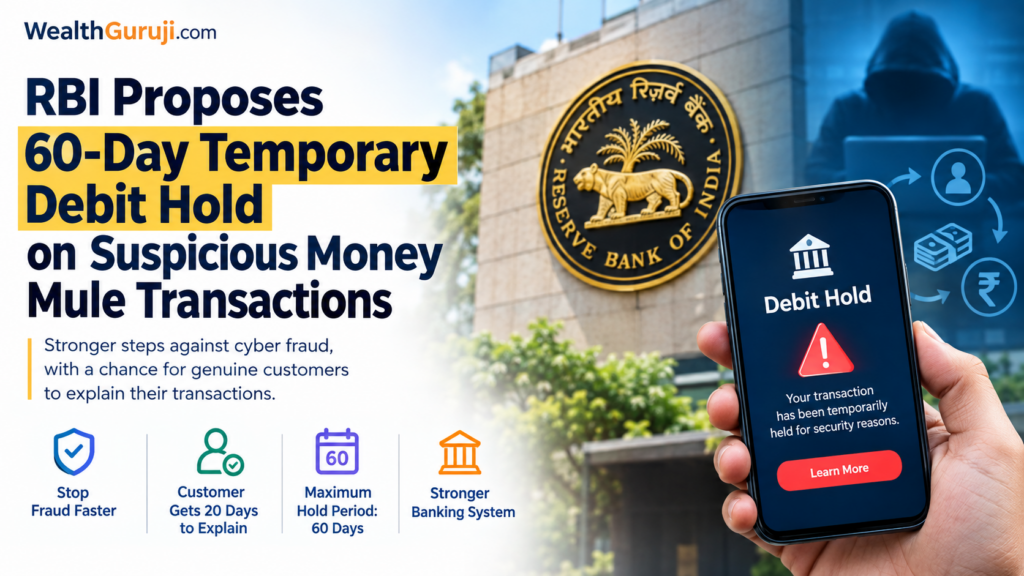
Under the proposed RBI (Know Your Customer) Amendment Directions, 2026, banks may be allowed to put a temporary debit hold for up to 60 days on transactions or accounts suspected of being linked to money mule activity.
The proposal is part of the RBI’s efforts to strengthen the banking system against digital fraud while also giving genuine customers an opportunity to explain transactions that may have been flagged.
The RBI has currently issued the proposal as a draft for consultation. Therefore, the final rules may change before they come into effect.
What Is a Money Mule Account?
A money mule account is a bank account that is used to receive or transfer money connected with fraud or other illegal activity.
In some cases, a person may knowingly allow criminals to use their bank account. In other cases, the account holder may not fully understand where the money came from.
Fraudsters may use such accounts to move money received through:
- Online scams
- Phishing
- Fake investment schemes
- Identity theft
- UPI fraud
- Fake job offers
- Social engineering scams
- Other cyber-enabled financial frauds
Because money can move quickly through digital banking channels, identifying and stopping such transactions has become an important challenge for banks.
RBI’s Proposed 60-Day Debit Hold
The RBI’s draft proposes that banks may place a Temporary Debit Hold on a suspected money mule transaction.
If the entire bank account is identified as a suspected money mule account, the bank may also place the hold on the account.
The RBI’s draft specifically says that an account-level debit hold should be used only in exceptional circumstances and as a last resort.
This means the proposal is not about automatically freezing every transaction that looks unusual. Banks are expected to follow defined procedures before taking such action.
Why Is RBI Proposing This Change?
Digital payments have grown rapidly in India. While this has made banking faster and more convenient, it has also created new opportunities for cybercriminals.
Fraudsters often try to move stolen money through several bank accounts before it can be traced.
Money mule accounts can play an important role in this process.
The proposed RBI framework is intended to help banks:
- Identify suspicious transactions faster
- Stop further movement of suspected funds
- Give customers an opportunity to explain transactions
- Coordinate with law-enforcement agencies
- Follow a more standard process across banks
The RBI’s existing KYC framework already requires regulated entities to carry out ongoing due diligence and monitor transactions.
Customer Will Get an Opportunity to Explain
One of the important parts of the proposed system is that customers will have an opportunity to explain why a transaction is genuine.
Once a temporary debit hold is placed, the bank would notify the customer and provide information about the reason for the action and the process for responding.
Under the proposed framework, the customer would generally get 20 days to submit an explanation or supporting documents.
For example, if a genuine business payment is mistakenly flagged, the customer may be able to provide:
- Invoice
- Sale or purchase agreement
- Payment receipt
- Bank statement
- Business records
- Other documents supporting the transaction
This is important because a genuine transaction can sometimes look unusual to an automated fraud-monitoring system.
Bank May Have to Decide Within 10 Days
After receiving the customer’s explanation, the bank would examine the information and carry out additional checks if required.
If the bank is satisfied with the explanation, the temporary debit hold would be removed.
The proposed framework provides a time-bound process for the bank to take a decision after receiving the customer’s explanation.
If the customer does not respond, the bank would also have a defined period to decide how the case should be handled.
The aim is to prevent genuine customers from being left without clarity for an indefinite period.
What Happens If the Bank Is Not Satisfied?
If the bank is not satisfied with the customer’s explanation, the matter may be referred to the relevant law-enforcement authority through the prescribed cyber-fraud reporting system.
The authorities can then provide further directions to the bank.
If there is no contrary instruction from the relevant authority, the proposed framework provides for a maximum temporary debit-hold period of 60 days.
It is important to understand that the 60-day period is part of the proposed framework and should not be treated as a final rule until the RBI completes the process.
Proposed Timelines at a Glance
| Proposed requirement | Timeline |
| Customer gets time to explain | 20 days |
| Bank’s decision after receiving explanation | Within 10 days |
| Maximum temporary debit hold in the proposed framework | 60 days |
| Suspected transaction threshold mentioned in the draft/reporting | ₹1,000 or more |
These provisions are based on the current draft and reporting around the RBI proposal. The final directions may contain changes.
What Should Bank Customers Do?
Customers should be careful when receiving money from unknown people or allowing someone else to use their bank account.
A simple rule is:
Never allow another person to use your bank account to receive or transfer money just because they promise you a commission.
Such arrangements can expose you to serious financial and legal problems if the money is connected with fraud.
If your bank places a temporary debit hold on a transaction, do not panic. Instead:
- Contact your bank through its official customer service channel.
- Ask why the transaction has been flagged.
- Provide genuine documents supporting the transaction.
- Respond within the prescribed time.
- Keep copies of all communication with the bank.
- Do not try to move suspicious funds through another account.
Why Keeping Financial Records Is Important
The proposed RBI framework also highlights the importance of proper records.
For individuals and businesses, keeping invoices, payment records, contracts and bank statements can make it easier to explain legitimate transactions if a bank raises a query.
This is particularly important for business owners and people who regularly receive large payments.
Good financial record-keeping is also an important part of a broader financial plan. You can read more about this in WealthGuruji’s guide to Financial Wealth Building Strategy.
RBI’s Focus on Cyber Fraud Is Increasing
The proposed debit-hold system is part of a broader effort to strengthen India’s financial system against cyber fraud.
Banks are increasingly using transaction-monitoring systems to identify unusual patterns.
A transaction may be flagged because of factors such as:
- Unusual transaction behaviour
- Rapid movement of funds
- Multiple incoming and outgoing transactions
- Activity that does not match the customer’s normal profile
- Links with accounts already associated with suspicious activity
However, an unusual transaction does not automatically mean that a customer has committed fraud.
This is why the proposed process gives customers an opportunity to explain the transaction.
What Does This Mean for Digital Banking Users?
For ordinary bank customers, the proposal is a reminder that safe banking practices are becoming more important.
Digital payments are convenient, but customers should know who they are paying and why they are receiving money.
People should be especially careful with offers such as:
“Receive money in your account and transfer it to another account. You can keep a commission.”
Such offers may look like easy ways to earn money, but they can expose the account holder to money-mule risks.
How This Can Affect Businesses
Small businesses, freelancers, traders and professionals often receive payments from multiple customers.
A legitimate business transaction could sometimes look unusual to a bank’s monitoring system, particularly when there are large or frequent payments.
Businesses should therefore maintain proper records of:
- Customer invoices
- Purchase orders
- Contracts
- GST-related documents, where applicable
- Payment confirmations
- Delivery records
- Bank statements
Keeping clear records can make it easier to explain the source and purpose of funds if the bank asks questions.
A Broader Lesson About Managing Money
The RBI proposal is mainly about banking security, but it also highlights a wider financial lesson: protecting your money is as important as earning and investing it.
Building wealth involves more than choosing investments. It also requires managing debt, maintaining emergency savings, protecting assets and keeping financial transactions organised.
WealthGuruji’s Financial Wealth Building Strategy explains how saving, investing, debt management and financial protection can work together as part of a long-term plan.
For readers interested in diversification, WealthGuruji also covers Financial Wealth Building Strategy Using Physical Gold, which discusses the role gold can play alongside other financial assets.
Similarly, investors considering property can read Financial Wealth Building Strategy Using Real Estate for a broader look at property, rental income, home loans and long-term wealth creation.
When Could the New RBI Rules Come Into Effect?
The RBI’s proposal is currently in the draft stage.
The central bank has invited comments on the Draft Reserve Bank of India (Know Your Customer) Amendment Directions, 2026.
The proposed framework is therefore not yet a final regulation.
Banks, customers and businesses should wait for the final RBI directions before treating the proposed timelines and procedures as mandatory requirements.
What Does the 60-Day Proposal Mean?
The proposed 60-day limit is significant because it aims to create a clear time frame for temporary debit restrictions.
At the same time, the framework gives banks a way to act quickly when they suspect that money is connected with cyber fraud.
The basic approach can be understood as:
Identify → Hold → Notify → Allow Explanation → Review → Decide → Refer to Authorities if Required
This could help create a more consistent approach across banks while protecting genuine customers from unnecessarily long restrictions.