PM Modi’s Independence Day 2026 Announcements: Big Push for Jobs, Growth, GST Reforms and a Developed India
A New Roadmap for India’s Future
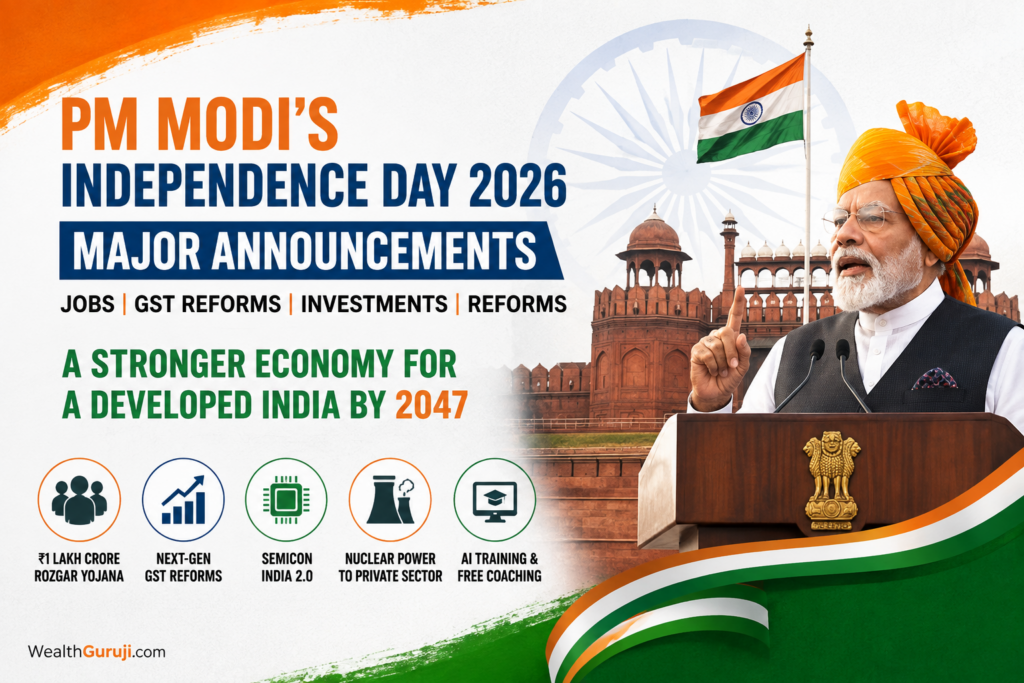
In his Independence Day 2026 speech from the Red Fort, Prime Minister Narendra Modi outlined several major initiatives aimed at creating jobs, strengthening the economy, supporting businesses, and preparing India for the future.
The announcements covered employment, tax reforms, semiconductor manufacturing, artificial intelligence, women’s empowerment, clean energy, and economic reforms. Together, these initiatives are designed to help India move closer to its goal of becoming a developed nation by 2047.
For young job seekers, entrepreneurs, small businesses, investors, and industries, these announcements could have a significant impact in the coming years.
₹1 Lakh Crore PM Viksit Bharat Rozgar Yojana
Major Employment Scheme for India’s Youth
One of the biggest announcements was the launch of the PM Viksit Bharat Rozgar Yojana, a large-scale employment scheme with an allocation of ₹1 lakh crore.
The government aims to support more than 3 crore young Indians through this program.
Key Benefits
- First-time employees joining private sector jobs will receive ₹15,000 per month as financial support.
- Companies that create more jobs will be eligible for government incentives.
- The scheme is expected to encourage hiring and improve employment opportunities across sectors.
For many young professionals starting their careers, this support can provide financial stability during the early stages of employment.
Major GST Reforms on the Horizon
Relief for Businesses and Consumers
The Prime Minister announced that the government is working on the next phase of GST reforms.
The goal is to make the tax system simpler, more efficient, and easier for businesses and consumers.
Expected Changes
- Lower tax rates on selected essential goods and services.
- Simplification of GST slabs.
- Reduced compliance burden for MSMEs and small businesses.
- Easier tax filing and reporting processes.
A simplified GST structure can help businesses save time and reduce administrative costs while making products and services more affordable for consumers.
Reform Task Force to Drive Economic Growth
Focus on Faster Decision-Making and Better Governance
The government will create a dedicated Reform Task Force to guide future economic reforms.
This task force will focus on removing unnecessary regulations, improving government processes, and supporting business growth.
Main Objectives
- Reduce red tape and procedural delays.
- Improve ease of doing business.
- Modernize governance systems.
- Support India’s long-term goal of becoming a $10 trillion economy.
Strong policy reforms often play a key role in attracting investment and boosting economic growth.
Lakhpati Didi Mission Expanded
Greater Focus on Women’s Financial Empowerment
The government highlighted the success of the Lakhpati Didi initiative, which helps rural women become financially independent through entrepreneurship and self-employment opportunities.
After achieving the earlier target of 3 crore women, the government has now doubled the goal.
New Target
6 crore Lakhpati Didis
This initiative aims to increase household income, strengthen self-help groups, and create more women-led businesses in rural India.
Women’s participation in the economy continues to be an important driver of inclusive growth.
Semicon India 2.0: Boost for Semiconductor Manufacturing
Strengthening India’s Technology Ecosystem
India’s semiconductor industry received a major boost with the announcement of Semicon India 2.0.
The government has approved an investment plan worth ₹1,27,500 crore to expand domestic chip manufacturing.
What This Means
- India’s first domestically manufactured semiconductor chips are expected to reach the market this year.
- Additional semiconductor manufacturing plants are planned over the coming years.
- The initiative aims to reduce dependence on imported chips.
As technology becomes increasingly important across industries, semiconductor manufacturing is expected to play a critical role in India’s economic future.
Nuclear Energy Sector Opens to Private Participation
Expanding Clean Energy Capacity
In a significant policy shift, the government announced plans to allow greater private sector participation in nuclear energy.
The objective is to increase clean energy production and strengthen long-term energy security.
Key Plans
- Construction of 10 new nuclear reactors.
- Expansion of nuclear power generation capacity.
- Increased investment in clean and reliable energy sources.
As India’s energy demand continues to grow, nuclear power could become an important part of the country’s energy mix.
National Deepwater Exploration Mission
Reducing Dependence on Imported Energy
India also announced the launch of the National Deepwater Exploration Mission, known as Samudra Manthan.
The mission will focus on exploring offshore resources and identifying new energy reserves.
Goals of the Mission
- Discover domestic oil and gas reserves.
- Increase energy self-reliance.
- Reduce spending on imported fuel.
- Strengthen long-term energy security.
Developing domestic energy resources can help improve economic stability and reduce external dependence.
AI Training for 1 Crore Youth
Preparing India’s Workforce for the Future
Artificial Intelligence is transforming industries around the world, and India is preparing its workforce for this change.
The government announced a nationwide initiative to provide AI training to 1 crore young Indians.
Areas of Focus
- Artificial Intelligence skills.
- Emerging technologies.
- Digital workforce development.
- Future-ready employment opportunities.
The program is expected to help young professionals build skills that are increasingly in demand across industries.
Free Online Coaching for Competitive Exams
Making Quality Education More Accessible
To reduce the financial burden on students and families, the government plans to launch free online coaching platforms for competitive examinations.
Expected Benefits
- Access to quality learning resources.
- Lower dependence on expensive coaching institutes.
- Better opportunities for students from middle-class and low-income families.
- Wider reach across urban and rural areas.
This initiative aims to make exam preparation more affordable and accessible for millions of students.
A New Goal for Indian Businesses
50 Indian Companies in the Fortune 500
The Prime Minister also challenged Indian businesses to expand globally and become larger, stronger, and more competitive.
The Target
At least 50 Indian companies should be part of the Fortune 500 list within the next decade.
Achieving this goal would reflect India’s growing economic strength and the global success of its businesses.
The Sapta Dhara Vision
Seven Streams of Strength for a Developed India
All these announcements were presented under a new development framework called Sapta Dhara, which translates to Seven Streams of Strength.
This framework brings together the government’s priorities for the coming decades.
Key Areas of Focus
- Economic growth
- Employment generation
- Manufacturing expansion
- Technology and innovation
- Women’s empowerment
- Energy security
- Governance reforms
The idea is to create a strong foundation that supports sustainable growth and helps India achieve its vision of becoming a developed nation by 2047.
Final Thoughts
The announcements made during Independence Day 2026 reflect a long-term strategy focused on jobs, economic reforms, technology, manufacturing, energy security, and social development.
From the ₹1 lakh crore employment scheme and GST reforms to semiconductor manufacturing, AI training, and women-led economic growth, the government has outlined an ambitious roadmap for the future.
The success of these initiatives will ultimately depend on effective implementation, industry participation, and continued policy support. If executed well, they have the potential to create new opportunities, strengthen the economy, and accelerate India’s journey toward becoming a developed nation by 2047.