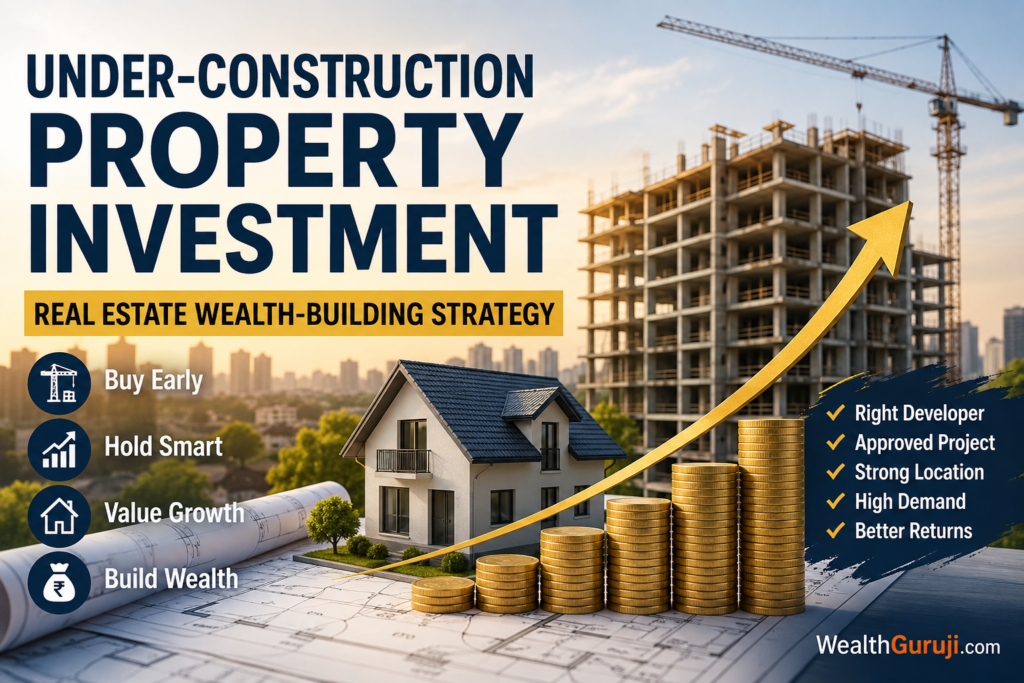
Under-Construction Property Investment – Real Estate Wealth-Building Strategy
Under-construction property investment is one of the strategies investors use to build wealth through real estate.
The idea is simple. You buy a property when the project is still under construction, hold it while the project develops, and sell it later when the property’s market value has potentially increased.
But there is an important point to understand.
Buying early does not automatically mean making a profit.
The success of an under-construction property investment depends on several factors, including the developer’s track record, project approvals, location, construction progress, market demand, purchase price, financing cost and your exit plan.
When these factors are carefully checked, an under-construction property can become a useful part of a long-term real estate wealth-building strategy.
What Is Under-Construction Property Investment?
Under-construction property investment means buying a residential or commercial property before the project is completed.
For example, you may purchase an apartment when the project is at the early construction stage. As construction progresses, the property may become more valuable because the project gets closer to completion and the surrounding area may also develop.
The investor can then choose to:
- Sell the property after substantial construction progress
- Sell it near completion
- Sell it after possession
- Hold it for rental income and long-term appreciation
The basic strategy is:
Buy Early → Hold → Construction Progresses → Property Value May Increase → Sell or Hold
The important word here is “may.”
Property prices do not always increase. Investors should never assume that appreciation is guaranteed.
Why Do Investors Buy Under-Construction Properties?
There are several reasons investors consider this type of real estate investment.
1. Potential for Capital Appreciation
One of the main reasons is the possibility of property price appreciation during the construction period.
A property purchased at an early stage may become more valuable as:
- Construction progresses
- The project approaches completion
- Infrastructure improves
- The locality develops
- Demand increases
- Available inventory reduces
However, appreciation depends on the market. A property can also remain flat in value for several years.
2. Opportunity to Enter at an Early Price
Developers may have different pricing stages during the life of a project.
Prices can change as construction progresses and inventory is sold.
For an investor, entering at the right price can be important because the purchase price directly affects future returns.
But do not assume that every launch price is a bargain.
Always compare the price with similar properties in the same locality.
3. More Choice of Properties
Early investors may have a wider choice of:
- Floors
- Apartment sizes
- Floor plans
- Views
- Orientations
- Parking options
- Preferred units
This can be useful because some units are easier to resell than others.
For example, a well-planned apartment with good light, ventilation, floor height and location within the project may attract more buyers in the future.
4. Benefit From Local Development
Real estate values are strongly connected to the development of the surrounding area.
A locality can become more attractive when it gets better:
- Roads
- Public transport
- Metro connectivity
- Employment opportunities
- Schools
- Hospitals
- Shopping areas
- Restaurants
- Social infrastructure
If genuine development takes place around the project, it can support future property demand.
But investors should distinguish between announced projects and completed infrastructure. Future infrastructure should not be treated as a guaranteed source of appreciation.
The Developer Is One of the Most Important Factors
When buying an under-construction property, you are not only buying an apartment.
You are also depending on the developer to complete the project as promised.
This is why developer due diligence is extremely important.
Before investing, study the developer’s previous projects.
Look at:
- Completed projects
- Construction quality
- Delivery record
- History of delays
- Reputation among existing buyers
- Financial strength
- Quality of maintenance
- Customer complaints
- Legal disputes, if any
If possible, visit a completed project of the same developer.
Talk to existing residents. Ask them about possession, construction quality, common areas, maintenance and how the developer handled customer issues.
This kind of practical research can tell you things that a brochure cannot.
Check RERA and Other Project Approvals
Legal and regulatory due diligence should never be skipped.
Before booking an under-construction property, verify the project’s RERA registration and available project information with the relevant state RERA authority.
Depending on the project, location and applicable regulations, investors should also check:
- Land title
- Approved building plans
- Development permissions
- Commencement-related approvals
- Environmental approvals, where applicable
- Fire-related approvals, where applicable
- Encumbrances
- Litigation information
- Promoter details
- Project completion timeline
Do not depend only on information provided by a salesperson.
Important property documents should be independently checked. For a significant investment, taking advice from a qualified property lawyer can be worthwhile.
Location Matters More Than the Brochure
A beautiful project brochure does not make a property a good investment.
Location creates long-term demand.
Before investing, study the locality carefully.
Check Connectivity
Look at the property’s access to:
- Major roads
- Highways
- Public transport
- Metro
- Railway stations
- Airports
- Important business districts
Check Employment Hubs
Areas close to IT parks, business districts, industrial areas and other employment centres can have stronger housing demand.
Check Social Infrastructure
Look for:
- Schools
- Colleges
- Hospitals
- Shopping centres
- Markets
- Restaurants
- Entertainment facilities
Check Future Development
Study planned infrastructure and development in the area.
But do not buy a property only because someone says that a new road, metro line or business hub is “coming soon.”
Check the status and credibility of the proposed development.
Do Not Buy Just Because the Property Is Cheap
This is one of the most important lessons for property investors.
A cheap property is not necessarily a good investment.
Sometimes a property is cheaper because the location has:
- Low demand
- Poor connectivity
- Oversupply
- Limited employment
- Weak rental demand
- Many competing projects
Instead of asking:
“How cheap is this property?”
Ask:
“Why is this property cheaper, and what will create future demand?”
That question can help you avoid many poor investment decisions.
Study the Local Property Market
Before investing, compare the project with other properties nearby.
Check:
- Current property prices
- Recent resale prices
- Rental rates
- New project prices
- Unsold inventory
- Number of competing projects
- Buyer demand
- Construction activity
- Future supply
For example, if a project is priced at ₹8,000 per sq. ft. while similar projects are selling at ₹7,000–₹7,500 per sq. ft., find out why.
The project may offer better quality, amenities or location.
But it may also simply be overpriced.
Market comparison is an important part of property investment research.
Understand the Construction Stage
The stage at which you buy can affect both the potential return and the level of risk.
Early Construction Stage
Possible advantage: Lower price and better choice of units.
Possible risk: Longer waiting period and greater construction uncertainty.
Mid-Construction Stage
Possible advantage: You can see actual construction progress.
Possible risk: Prices may already have increased.
Near Completion
Possible advantage: Lower construction and waiting risk.
Possible risk: The property may already be priced closer to its expected completed value.
There is no universal rule that says an investor must always buy at launch.
The right stage depends on the project’s price, developer, construction progress, market demand and your investment objective.
Calculate the Complete Investment Cost
Many investors make a simple mistake.
They calculate:
Selling Price – Purchase Price = Profit
Real estate investing is not that simple.
Your total investment cost may include:
- Property purchase price
- Stamp duty
- Registration charges
- Applicable taxes
- Brokerage
- Legal expenses
- Documentation charges
- Loan processing charges
- Interest cost
- Maintenance-related charges
- Other applicable project charges
When selling, you may also have:
- Brokerage
- Documentation expenses
- Applicable taxes and charges
Therefore, use a more realistic formula:
Net Profit = Selling Price – Total Investment Cost – Selling Costs – Applicable Taxes
This gives you a better idea of the actual return.
Example: How Under-Construction Property Investment Can Work
Consider a simple example.
An investor buys an apartment for:
Purchase Price: ₹60 lakh
Suppose the investor’s additional purchase and holding costs are:
₹5 lakh
So the total investment becomes:
₹65 lakh
After a few years, the property is sold for:
₹78 lakh
Assume selling expenses and applicable taxes total:
₹3 lakh
The approximate net profit would be:
₹78 lakh – ₹65 lakh – ₹3 lakh = ₹10 lakh
So the investor’s approximate net profit is ₹10 lakh.
This is only a simplified example. Actual returns will depend on financing, holding period, taxes, transaction costs and market conditions.
Home Loan and Leverage: Be Careful
A home loan can help investors purchase a property without paying the entire amount from their own funds.
This is known as financial leverage.
Leverage can increase the return on your own capital when the property performs well.
But it can also increase your risk.
Suppose property prices remain unchanged for several years.
During that period, the investor may still have to pay:
- Loan interest
- EMI
- Construction-linked payments
- Other property expenses
If the project is delayed, the holding period may become longer than expected.
Therefore, do not take a loan simply because the bank is willing to provide it.
Before investing, calculate whether you can comfortably manage the loan even if the property does not appreciate as quickly as expected.
Construction-Linked Payment Plans Need Attention
Many under-construction projects have payment schedules linked to construction milestones.
Before booking, understand exactly when the payments will become due.
Check:
- Booking amount
- Payment schedule
- Construction-linked instalments
- Loan disbursement process
- Interest obligations
- Possession timeline
- Consequences of delayed payments
A property may look affordable when you consider only the booking amount.
The real question is:
Can you comfortably manage the complete payment schedule?
Have an Exit Strategy Before You Buy
One of the biggest mistakes in property investment is buying first and thinking about selling later.
Before investing, decide what you want to achieve.
For example:
Target holding period: 3–5 years
Target price: ₹X
Exit point: Near completion or after a specific construction milestone
Your exit strategy may be based on:
- Construction progress
- Target property price
- Market demand
- Infrastructure development
- Completion of the project
- Possession
- Changes in your financial requirements
The exit strategy should be flexible, but having one gives you a clear investment framework.
Gross Appreciation Is Not Your Actual Profit
Suppose you buy a property for ₹60 lakh and sell it for ₹78 lakh.
The price appreciation is:
₹18 lakh
But this does not mean you earned ₹18 lakh.
If you spent ₹7 lakh on purchase-related and holding costs and another ₹3 lakh on selling expenses and applicable taxes, your actual profit could be much lower.
This is why experienced investors look at net returns rather than headline appreciation.
How to Calculate ROI on Property Investment
A simple formula is:
ROI = Net Profit ÷ Total Investment × 100
For example:
Total Investment = ₹65 lakh
Net Profit = ₹10 lakh
ROI:
₹10 lakh ÷ ₹65 lakh × 100 = approximately 15.38%
But there is another important factor:
How long did it take to earn that return?
A 15% return over one year is very different from a 15% return over five years.
Therefore, investors should also consider the annualised return when comparing property investments.
Major Risks of Under-Construction Property Investment
Under-construction property can offer attractive opportunities, but investors must understand the risks.
1. Construction Delay
A delay can increase your holding period and financing cost.
2. Developer Risk
Financial or operational problems with the developer can affect project progress.
3. Market Risk
Property prices may remain flat or decline.
4. Resale Risk
You may not find a buyer at your expected selling price.
5. Oversupply
Too many similar properties in the same locality can affect resale demand.
6. Interest Cost
A longer holding period can increase the total cost of a financed investment.
7. Cash-Flow Pressure
Construction-linked payments can become difficult if your income or financial situation changes.
8. Legal and Approval Issues
Problems related to land, approvals or project documentation can create significant risks.
Red Flags You Should Not Ignore
Be careful if you come across:
- Guaranteed appreciation promises
- Guaranteed returns without proper basis
- Pressure to book immediately
- Unclear RERA information
- Poor construction progress
- Repeated project delays
- Unclear property documentation
- Weak developer track record
- Very high unsold inventory
- Prices much higher than comparable projects
- Poor connectivity
- Weak end-user demand
A salesperson’s promise should never replace your own due diligence.
Under-Construction Property vs Ready-to-Move Property
| Factor | Under-Construction Property | Ready-to-Move Property |
| Entry Price | May be lower in some projects | Usually higher |
| Construction Risk | Higher | Lower |
| Waiting Period | Yes | Very little |
| Rental Income | Usually starts later | Can start sooner |
| Unit Choice | Often better at early stage | More limited |
| Appreciation Potential | Can be attractive | Depends on market |
| Possession Risk | Exists | Much lower |
The better option depends on your objective.
If you want immediate use or rental income, a ready property may be more suitable.
If you are comfortable waiting and taking construction risk for potential capital appreciation, an under-construction property may be worth considering.
Who Should Consider This Investment Strategy?
Under-construction property investment may be suitable for people who:
- Have a medium- or long-term investment horizon
- Have stable income or cash flow
- Can handle construction-linked payments
- Have an emergency fund
- Can tolerate construction risk
- Understand the local property market
- Have researched the developer
- Have a realistic exit plan
It may not be suitable for someone who needs immediate rental income or cannot handle a delayed possession.
Common Mistakes Property Investors Make
Buying Only Because of a Discount
A discount is useful only when the property itself is worth buying.
Ignoring the Developer
Developer quality can directly affect construction progress and possession.
Not Checking Documents
Never rely only on a brochure or verbal assurance.
Ignoring Nearby Competition
A project may struggle to appreciate if several similar properties are competing for the same buyers.
Assuming Prices Always Rise
Real estate markets can experience slow periods.
Forgetting Loan Costs
Interest can significantly affect your final return.
Having No Exit Plan
Know why and when you may want to sell before investing.
Under-Construction Property Investment Checklist
Before booking, review these points.
Developer
☐ Track record
☐ Completed projects
☐ Delivery history
☐ Construction quality
☐ Reputation
Project
☐ RERA registration
☐ Relevant approvals
☐ Land/title information
☐ Construction progress
☐ Expected completion date
☐ Project specifications
Location
☐ Road connectivity
☐ Public transport
☐ Employment centres
☐ Schools and hospitals
☐ Existing demand
☐ Future infrastructure
☐ Competing projects
Financials
☐ Property price
☐ Stamp duty
☐ Registration charges
☐ Applicable taxes
☐ Brokerage
☐ Loan interest
☐ Other charges
☐ Selling costs
Exit Strategy
☐ Target selling price
☐ Expected holding period
☐ Potential future buyers
☐ Resale demand
☐ Alternative exit options
How to Build Wealth Through Under-Construction Property Investment
Real estate wealth is generally built over time.
A disciplined investor can follow a simple process:
Research → Verify → Calculate → Invest → Monitor → Exit
Research the developer, project and locality.
Verify RERA details, approvals and important documents.
Calculate the total cost and realistic expected return.
Invest only when the investment fits your financial position.
Monitor construction and market conditions.
Exit when the investment reaches your target or when circumstances justify selling.
This approach is more reliable than buying a property simply because someone says its price will increase.
Final Thoughts
Under-construction property investment can be a useful real estate wealth-building strategy, but it requires patience, research and proper risk management.
The goal should not be simply to buy early and hope to sell at a higher price.
A stronger investment decision comes from finding the right combination of:
Credible Developer + Strong Location + Proper Approvals + Genuine Demand + Sensible Purchase Price + Manageable Financing + Clear Exit Strategy
Remember that property appreciation is never guaranteed.
The best real estate investments are usually not the ones with the loudest promises. They are the ones where the numbers, location, developer, legal documents and future demand make sense.
If you are planning to invest in an under-construction property, take time to verify the facts, calculate the complete cost and understand the risks before committing your money.
Real estate wealth is built through informed decisions, patience and financial discipline.
Frequently Asked Questions
1. What is under-construction property investment?
Under-construction property investment means purchasing a property before the project is completed and holding it with the objective of benefiting from potential appreciation, future rental income or long-term ownership.
2. Is under-construction property a good investment?
It can be a good investment when the developer, location, approvals, price and future demand are favourable. However, property appreciation is not guaranteed.
3. How can I make money from an under-construction property?
An investor may make money if the property’s market value increases and the property is sold at a price higher than the total investment cost. Another option is to hold the property and generate rental income after completion.
4. What should I check before buying an under-construction property?
Check the developer’s track record, RERA registration, project approvals, title information, construction progress, location, competing properties, total cost and potential resale demand.
5. Is it better to buy at the launch stage?
The launch stage may provide better unit choices and potentially attractive pricing, but it also means a longer waiting period and greater construction risk. The decision should be based on the specific project.
6. What are the biggest risks?
The major risks include construction delays, developer problems, market downturns, oversupply, financing costs, legal issues and difficulty finding a buyer at your expected selling price.
7. How long should I hold an under-construction property?
There is no fixed holding period. It depends on the project timeline, market conditions, your financial position and investment objective. Decide your expected holding period before investing.
8. Should I use a home loan for property investment?
A home loan can help finance the investment, but it also increases financial obligations. Before borrowing, calculate the EMI, interest cost and your ability to manage payments if the project or market takes longer than expected.
9. How do I calculate actual profit?
Subtract the complete purchase cost, holding costs, selling expenses and applicable taxes from the final selling price. The remaining amount is your approximate net profit.
10. Is under-construction property better than ready-to-move property?
Neither is automatically better. Under-construction properties may offer potential capital appreciation but carry construction risk. Ready-to-move properties provide greater certainty and may generate rental income sooner.
11. Can an under-construction property lose value?
Yes. Property prices can remain stagnant or decline depending on market conditions, supply, demand, location, economic conditions and project-specific issues.
12. What is the most important factor in under-construction property investment?
There is no single factor. Developer quality, location, legal due diligence, purchase price and future demand are all important.
13. Should I invest only because a developer promises high appreciation?
No. Appreciation projections are not guarantees. Make your investment decision based on independent research, comparable property prices, actual demand and realistic financial calculations.
14. Is under-construction property suitable for first-time investors?
It can be, but first-time investors should take extra care with documentation, financing, developer evaluation and market research. Professional legal or financial advice may be useful for a significant investment.
Key Takeaway
Under-construction property investment is not a shortcut to wealth. It is a strategy that rewards careful selection, proper due diligence, patience and disciplined financial planning.