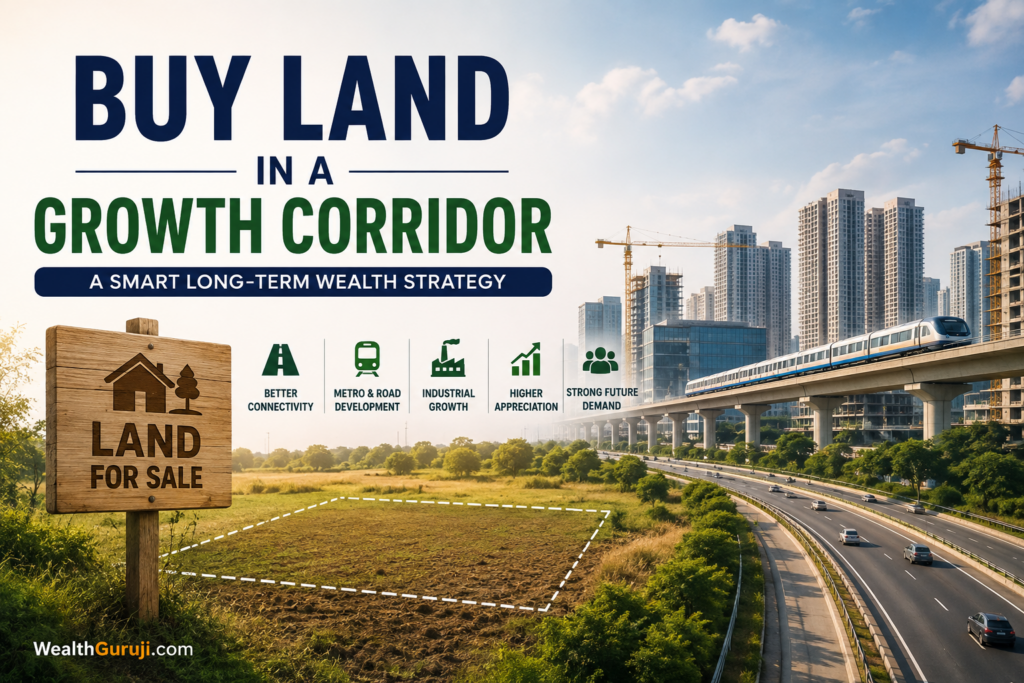
Buy Land in a Growth Corridor: A Smart Long-Term Real Estate Strategy
Buying land in a developing area can be a good way to build wealth over the long term. Many investors look for locations where new roads, highways, metro lines, industries, IT parks, or business centres are coming up.
The basic idea is simple:
Buy land at a reasonable price → wait for the area to develop → benefit from possible appreciation in land value.
But land investment is not as simple as buying a plot and waiting for the price to increase. The location, legal documents, infrastructure, future demand, and purchase price all need careful attention.
What Is a Growth Corridor?
A growth corridor is an area that is expected to develop because of better infrastructure, improved connectivity, new businesses, and increasing economic activity.
For example, an area may initially have open land and limited development. Over time, a new highway may be built, a metro line may come closer, companies may start operations, and residential projects may begin.
As the area develops, more people may want to live, work, or run businesses there.
This can increase demand for land.
Some common signs of a growth corridor include:
- New highways and expressways
- Metro or railway connectivity
- Industrial areas
- IT parks and business hubs
- Airports and logistics centres
- New residential projects
- Schools and hospitals
- Shopping and commercial developments
- Government infrastructure projects
However, a planned project does not automatically mean that land prices will increase. Investors should verify the actual development plans before making a decision.
How Can Land in a Growth Corridor Build Wealth?
Land usually creates wealth through capital appreciation.
The process can be understood in a simple way:
Buy → Hold → Area Develops → Demand Increases → Land Value May Rise
Suppose you buy a plot in an area that is still developing.
At the time of purchase, there may not be many buildings, businesses, or facilities around the property.
After several years, the situation may change. Roads may improve, new companies may arrive, housing projects may be launched, and more people may start moving into the area.
If demand for land increases, the market value of your property may also increase.
You can then decide whether to:
- Continue holding the land
- Sell it
- Construct a property, if permitted
- Use it for another suitable purpose
The important point is that land appreciation is not guaranteed. Development may take longer than expected, or the expected demand may not develop.
Why Infrastructure Matters
Infrastructure is one of the most important factors to consider when investing in a growth corridor.
Good infrastructure makes an area easier to access and can encourage businesses and residents to move there.
Highways and Expressways
A new highway or expressway can improve connectivity between cities and important business locations.
Better road connectivity can make nearby areas more attractive for residential, commercial, and industrial development.
Metro Connectivity
Metro connectivity can make it easier for people to travel to offices, business districts, and other important locations.
Areas with good public transport can become more attractive to homebuyers and businesses.
Industrial Development
Factories, industrial parks, warehouses, and logistics centres can bring new jobs to an area.
When employment increases, demand for nearby housing, shops, services, and commercial properties may also increase.
IT and Business Hubs
IT parks and business centres can attract companies and professionals.
This can create demand for homes, rental properties, restaurants, shops, offices, and other services.
How to Identify a Good Growth Corridor
Finding a growth corridor requires more than looking at a map and choosing an undeveloped area.
You should look for signs of real and sustainable development.
1. Check Infrastructure Plans
Find out what major projects are planned for the area.
Look at:
- Roads
- Highways
- Metro lines
- Railway projects
- Ring roads
- Airports
- Industrial parks
- Business centres
More importantly, check whether these projects are officially approved and whether work has actually started.
2. Look for Employment Opportunities
People usually move to areas where they can find jobs and business opportunities.
If new companies, factories, IT parks, or commercial centres are coming up, the demand for nearby real estate may increase.
Employment growth is an important factor behind real estate demand.
3. Check Population Growth
A growing population can create demand for:
- Homes
- Shops
- Schools
- Hospitals
- Restaurants
- Offices
- Public services
Visit the area and see whether development is actually taking place.
New residential projects and increasing occupancy can be useful signs of growing demand.
4. Study Connectivity
Before buying land, check how easily the location can be reached.
Consider its distance from:
- Major roads
- Highways
- Metro stations
- Railway stations
- Airports
- Business districts
- Schools
- Hospitals
- Shopping areas
A cheap plot with poor connectivity may not necessarily be a good investment.
Residential Land or Commercial Land?
The right choice depends on your investment objective and the development potential of the location.
Residential Land
Residential plots may be suitable for:
- Building a house
- Future residential development
- Long-term investment
Demand generally depends on population growth, employment, connectivity, and the availability of basic facilities.
Commercial Land
Commercial land may be used for:
- Shops
- Offices
- Restaurants
- Hotels
- Warehouses
- Other permitted commercial activities
Commercial land can benefit from increasing business activity, but it usually requires more capital and careful research.
Always check the permitted land use before purchasing a plot.
One Important Limitation: Land Usually Does Not Generate Rental Income
This is an important point that every land investor should understand.
A vacant plot generally does not provide regular monthly income.
For example, an apartment can be rented out. A shop or office can also generate rent.
Vacant land, on the other hand, usually depends on future appreciation.
This means you need enough financial capacity to hold the land for several years without depending on it for monthly income.
For this reason, land can be more suitable for investors who have a long-term investment horizon.
Should You Buy Land Very Early?
Buying early in a developing area can sometimes provide an attractive entry price.
But buying too early can also increase risk.
For example, you may hear that a new highway, metro line, airport, or industrial project is coming to a particular area.
If you buy land based only on that information, you may have to wait many years if the project is delayed.
There is also a possibility that the project could be changed or cancelled.
A better approach is to look at several factors together:
Infrastructure + Employment + Connectivity + Population Growth + Current Demand + Reasonable Price
The more of these factors that are supported by reliable information, the stronger your investment case may be.
Never Ignore Legal Verification
Legal due diligence is one of the most important parts of buying land.
A good location does not make a property safe if there is a problem with its ownership or legal status.
Before purchasing, verify matters such as:
- Property ownership
- Title documents
- Previous ownership records
- Encumbrances
- Existing claims or loans
- Land-use classification
- Zoning
- Approved layout
- Survey records
- Legal access to the property
- Property tax records
- Pending disputes
- Government acquisition proposals
- Applicable development restrictions
Do not depend entirely on information provided by the seller or broker.
For a major investment, it is sensible to get the documents independently checked by a qualified property lawyer.
Don’t Believe Every Future Development Story
Real estate investors often hear attractive statements such as:
“The metro is coming here.”
“A major highway will pass nearby.”
“A large company is going to set up an office here.”
“Land prices will double in two years.”
Such claims should never be accepted without verification.
Before investing, check reliable and official sources wherever possible.
Also visit the location yourself.
Look at the roads, surrounding development, existing projects, infrastructure, and actual activity in the area.
Good investment decisions are based on facts, not rumours.
Example: Rajesh Buys Land in a Growth Corridor
Let’s take the example of Rajesh.
Rajesh wants to build long-term wealth through real estate. Instead of buying an expensive property in an already-developed location, he starts looking at areas that are growing.
He finds a location where:
- Road connectivity is improving.
- New residential projects are being developed.
- Employment opportunities are increasing.
- Basic facilities are becoming available.
- The location has good access to an established business area.
Before buying, Rajesh checks the property documents and gets the title verified.
He then buys a residential plot at a price that fits his financial capacity.
Rajesh does not expect the price to double in a year.
His plan is to hold the property for the long term.
If the area continues to develop and demand for land increases, the market value of his plot may appreciate.
At that point, he could decide to sell the property or develop it, subject to applicable rules and permissions.
The important part of Rajesh’s strategy is that he did not simply buy cheap land. He bought land after studying the location, development potential, legal status, and price.
Major Risks of Growth-Corridor Land Investment
Land investment can create wealth, but it also carries risks.
Infrastructure Delays
A road, metro line, or other project may take longer than expected.
Project Cancellation
A proposed project may be modified, postponed, or cancelled.
Slow Development
The area may develop much more slowly than expected.
Legal Problems
Ownership disputes, unclear titles, zoning problems, or other legal issues can create serious difficulties.
Low Liquidity
Land can take time to sell, particularly when the property market is weak.
High Purchase Price
If you pay too much because you expect future development, your potential return may be reduced.
No Regular Income
Vacant land generally does not provide monthly rental income.
Understanding these risks is essential before investing.
Common Mistakes Investors Should Avoid
Here are some common mistakes to watch out for:
- Buying land only because a broker promises high returns.
- Not checking the title properly.
- Ignoring land-use restrictions.
- Buying disputed property.
- Investing all available savings in one plot.
- Taking excessive loans to purchase land.
- Ignoring road access.
- Assuming every announced infrastructure project will be completed.
- Paying a very high price based on future expectations.
- Expecting quick profits.
Patience and proper research are important in land investment.
A Simple Checklist Before Buying Land
Before you buy land in a growth corridor, ask yourself these questions:
Location
Is the location well connected to important roads and business areas?
Infrastructure
Are major infrastructure projects officially planned or already under construction?
Employment
Are companies, industries, or business centres creating new employment?
Population
Are more people actually moving into the area?
Legal Status
Is the ownership clear? Are there any disputes or restrictions?
Land Use
Can the land legally be used for the purpose you have in mind?
Price
Is the asking price reasonable compared with similar properties nearby?
Holding Period
Can you hold the property comfortably for several years?
Exit Plan
If you want to sell later, who is likely to buy the property?
If you cannot answer these questions confidently, take more time to research before investing.
Is Buying Land in a Growth Corridor a Good Wealth-Building Strategy?
It can be a useful long-term real estate strategy, but it is not suitable for everyone.
The potential success of the investment depends on several factors:
- Location
- Purchase price
- Infrastructure development
- Employment growth
- Population growth
- Legal clarity
- Future demand
- Holding period
The main attraction is the possibility of capital appreciation.
The main limitation is that vacant land generally does not provide regular rental income.
For an investor who can wait patiently, has done proper due diligence, and chooses the location carefully, land in a genuine growth corridor can become an important part of a long-term wealth-building plan.
Final Thoughts
Buying land in a growth corridor is essentially an investment in the future development of a location.
The goal should not be to find the cheapest plot.
Instead, look for a location where connectivity, infrastructure, employment, population, and economic activity are moving in the right direction.
Do your research before buying. Verify the development plans. Check the property documents. Understand the permitted land use. Compare prices. Visit the location personally.
Most importantly, don’t invest based only on a promise of future appreciation.
Good real estate investing is about buying the right property, at a sensible price, in the right location, and having the patience to hold it for the long term.
Frequently Asked Questions
1. What is a growth corridor in real estate?
A growth corridor is an area that is expected to develop because of better infrastructure, connectivity, employment, business activity, and population growth.
2. Is buying land in a growth corridor a good investment?
It can be a good long-term investment if the location has genuine development potential, the property has clear legal ownership, and the purchase price is reasonable. However, returns are never guaranteed.
3. Does vacant land generate rental income?
Generally, no. Vacant land usually does not provide regular monthly rental income. The investment mainly depends on potential capital appreciation.
4. How long should I hold growth-corridor land?
Land investment is generally better suited to a long-term approach. The right holding period depends on the location, development speed, market conditions, and your financial goals.
5. What infrastructure should I look for?
Look at highways, expressways, metro lines, railway connectivity, airports, industrial parks, IT parks, logistics centres, and other projects that can improve connectivity and economic activity.
6. Should I buy land because a metro or highway is planned nearby?
Not without verification. Check whether the project is officially approved and whether work is actually progressing. Do not rely only on statements from brokers or sellers.
7. What is more important—price or location?
Both matter. A reasonable price is important, but location and future demand are critical. Cheap land in an area with poor connectivity may not provide the expected appreciation.
8. What legal checks should I perform?
Ownership, title, encumbrances, land-use classification, zoning, layout approval, road access, property records, disputes, and other applicable requirements should be checked before purchase. Independent legal advice is recommended.
9. Can land help build long-term wealth?
Yes. Carefully selected land can become part of a long-term wealth-building strategy when it is purchased at a sensible price in a location with genuine development potential. However, land investment also carries risks.
10. What is the biggest mistake when buying growth-corridor land?
One of the biggest mistakes is buying based on future development promises without verifying the facts. Investors should research the location, infrastructure, legal status, demand, and price before investing.