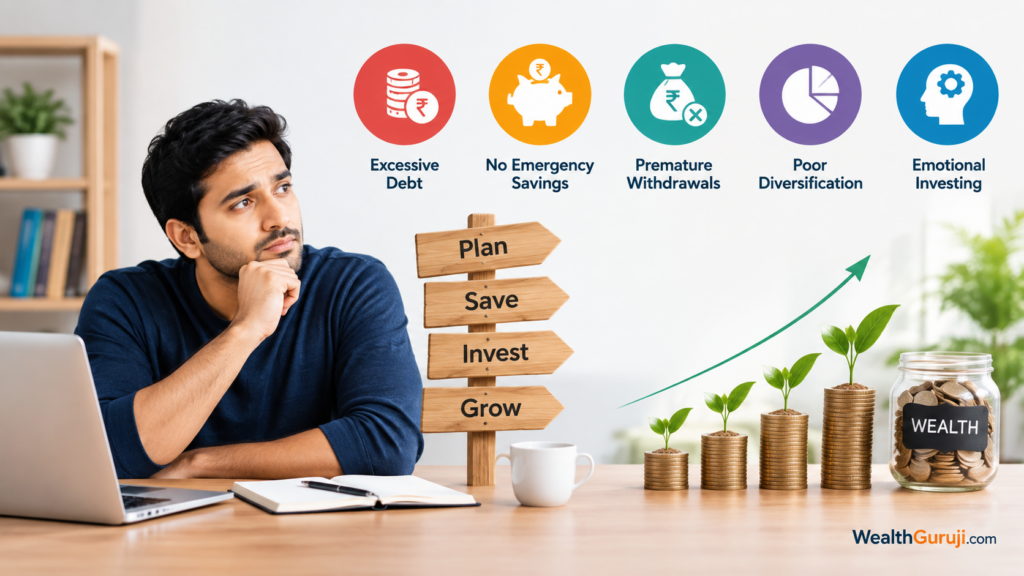
Common Wealth-Building Mistakes to Avoid: 5 Financial Mistakes That Can Slow Your Wealth Creation
Building wealth is usually a long-term process. It is not only about earning more money or finding an investment that delivers high returns. Your financial habits, debt decisions, emergency savings, investment discipline and ability to stay invested can all affect how much wealth you build over time.
Many people make reasonable incomes but still struggle to increase their net worth because of avoidable financial mistakes. Taking on excessive debt, having no emergency savings, withdrawing long-term investments too early, concentrating investments in a few assets and reacting emotionally to market movements can all weaken a wealth-building plan.
The good news is that these mistakes can often be corrected.
This guide explains some of the most common wealth-building mistakes, why they can be costly over the long term, and practical ways to avoid them.
The 5 Common Wealth-Building Mistakes to Avoid
| Mistake | What can go wrong | Better approach |
|---|---|---|
| Excessive debt | EMIs reduce savings and investment capacity | Borrow carefully and manage high-cost debt |
| No emergency savings | Unexpected expenses can force loans or premature withdrawals | Build accessible emergency savings |
| Premature withdrawals | Long-term compounding and retirement savings can be disrupted | Keep long-term money invested unless there is a genuine need |
| Poor diversification | One asset or investment can have an outsized impact on wealth | Spread investments according to goals and risk |
| Emotional investing | Panic selling and return chasing can damage long-term discipline | Follow a written investment plan |
1. Taking on Excessive Debt
Debt is not automatically bad. A suitable home loan or education loan, for example, can serve a long-term financial purpose.
The problem begins when debt grows faster than your ability to repay it comfortably.
How excessive debt can slow wealth creation
Suppose a person earns ₹1 lakh a month and has:
- ₹35,000 in household expenses
- ₹30,000 in loan EMIs
- ₹10,000 in other financial commitments
Only ₹25,000 remains before considering additional savings and investments.
Now imagine taking another large personal loan for a car upgrade, holiday or lifestyle purchase. The additional EMI can reduce the amount available for emergency savings and long-term investments.
Over time, the problem is not only the interest paid on the loan. It is also the wealth-building opportunity you may lose because less money is available to invest.
A recent MoneyHelper guide similarly emphasizes dealing with expensive debt and building emergency savings before putting money that may be needed soon into investments.
Signs that debt may be becoming a problem
Be careful when:
- EMIs consume a large part of your monthly cash flow.
- You repeatedly use credit cards to pay regular expenses.
- You take new loans to repay existing loans.
- You borrow for lifestyle spending rather than important goals.
- Debt prevents you from maintaining emergency savings.
- You cannot comfortably handle a temporary fall in income.
How to avoid excessive debt
Before taking a loan, ask:
Do I need this loan, and will I still be comfortable paying the EMI if my expenses increase or my income temporarily falls?
Prioritise high-cost debt repayment while maintaining essential savings. Also distinguish between productive borrowing and borrowing that mainly finances consumption.
Your overall financial plan should balance debt reduction, savings, protection and investment rather than focusing on only one of them.
2. Not Having an Emergency Fund
One of the easiest wealth-building mistakes to underestimate is having no emergency savings.
An emergency can be a medical expense, job loss, major repair, family requirement or unexpected period without income. Without accessible savings, many people turn to credit cards, personal loans or long-term investments.
The Consumer Financial Protection Bureau notes that emergency savings can help people deal with unexpected expenses and reduce the possibility that a financial shock turns into difficult debt.
Why an emergency fund matters for wealth creation
Imagine you have ₹5 lakh invested for a long-term goal.
A few months later, you suddenly need ₹1.5 lakh for an emergency. If you do not have separate cash savings, you may have to sell investments or take a loan.
That can disrupt your financial plan.
An emergency fund acts like a financial buffer between unexpected expenses and your long-term investments.
How much emergency savings should you keep?
There is no single number that works for everyone.
The right amount depends on:
- Income stability
- Number of dependants
- Monthly essential expenses
- Existing debt
- Insurance coverage
- Whether you are salaried or self-employed
- How easily you could replace your income
A useful starting framework is to maintain enough accessible money to cover several months of essential expenses, then adjust the amount according to your personal circumstances.
Where should emergency money be kept?
Emergency money should prioritise safety and access, not maximum returns.
The purpose is to have money available when you need it.
Your emergency fund should generally be separate from your long-term equity investments, retirement savings and money allocated for major long-term goals.
For a broader framework covering savings, debt, investing and financial protection, see Financial Wealth Building Strategy.
3. Making Premature Withdrawals From Long-Term Investments
Another common mistake is treating long-term investments as easily available spending money.
An investment may have been created for retirement, a child’s education or another long-term goal. Withdrawing it early can reduce the amount available for that future goal.
This is particularly important for retirement-oriented savings.
EPFO provides specific processes for final settlement and withdrawals in eligible circumstances, while retirement schemes such as NPS also have defined exit and withdrawal rules.
The lesson is not that you should never withdraw money.
The lesson is that the reason for the withdrawal matters.
The hidden cost of an early withdrawal
Suppose you have ₹2 lakh invested for retirement.
You withdraw ₹2 lakh today and use it for a non-essential expense.
You have lost more than ₹2 lakh from your long-term financial plan.
You have also lost the future growth that amount could potentially have generated.
For example, ₹2 lakh that remains invested for decades can potentially become much more valuable than ₹2 lakh spent today. The actual outcome depends on returns, taxes, fees and the investment product, but the basic principle is the importance of time and compounding.
EPF example
Changing jobs is one situation in which people may consider withdrawing accumulated EPF savings.
Instead of automatically cashing out, eligible employees can consider preserving and transferring their EPF savings where applicable.
WealthGuruji’s guide Avoid Premature EPF Withdrawals: How EPF Can Help Build Long-Term Wealth explains why unnecessary EPF withdrawals can weaken long-term retirement wealth.
Ask these questions before withdrawing long-term investments
- Is this a genuine financial need?
- Do I have an emergency fund?
- Can the expense be postponed?
- Is there another source of money?
- What long-term goal will this withdrawal affect?
- Am I giving up potentially valuable future compounding?
A withdrawal can sometimes be appropriate. But it should be a deliberate financial decision, not an automatic response to a short-term expense.
4. Poor Diversification
Putting too much money into one investment or one asset class creates concentration risk.
For example, imagine someone has:
- Most of their savings in one property
- A large amount in one company’s shares
- Almost no fixed-income investments
- Very little liquid savings
Even if that strategy has worked well in the past, a problem affecting one major holding could significantly change the person’s financial position.
SEBI Investor guidance explains that diversification across asset classes and within asset categories can help manage investment risk, although diversification cannot remove market-wide risks.
FINRA similarly describes asset allocation, diversification and rebalancing as important tools for managing investment risk.
Diversification does not mean owning everything
A common misunderstanding is that diversification means buying many different investments.
It does not.
Owning ten mutual funds that have very similar holdings may not provide much additional diversification.
Similarly, buying several properties in the same local market may still leave a person’s wealth heavily concentrated in real estate.
The goal is to build an investment mix that is appropriate for your:
- Financial goals
- Time horizon
- Risk tolerance
- Income
- Liquidity needs
A simple example
Consider two investors.
Investor A
- 90% in one asset
- 10% in cash
Investor B
- Multiple asset classes
- Diversified holdings within those asset classes
- Separate emergency savings
If the concentrated asset falls sharply, Investor A may face a much larger impact on total wealth.
Diversification does not guarantee profits or eliminate losses. It is a way of avoiding unnecessary dependence on one investment or one source of risk.
SEBI also recommends matching investments to the time horizon of the goal; money needed in the near term should generally not be exposed to investments whose value can fluctuate significantly.
5. Making Emotional Investment Decisions
Markets can create strong emotions.
When investments rise quickly, investors may feel pressure to buy more because everyone around them appears to be making money.
When markets fall, fear can encourage investors to sell without considering their original goals or investment horizon.
This is often called emotional investing.
Vanguard’s investor education material explains that emotions such as fear, excitement and overconfidence can influence financial decisions, particularly during periods of market uncertainty.
Morningstar also highlights the importance of controlling emotional reactions and avoiding short-term thinking during market uncertainty.
Common emotional investing mistakes
Panic selling
An investor sees a major market decline and sells a long-term investment simply because prices have fallen.
Chasing recent performance
An investment has performed strongly, so the investor buys it mainly because of its recent returns.
Trying to time the market
The investor repeatedly moves in and out of investments hoping to predict short-term highs and lows.
Following social media tips
Investment decisions are made because a stock, mutual fund or asset is trending online rather than because it fits a financial plan.
FINRA’s 2025 investor guidance notes that trying to chase returns or time markets can result in buying after prices have risen and selling when markets are falling.
How to control emotional investing
Create an investment process before emotions take over.
For example:
Set goals → Choose asset allocation → Invest regularly → Review periodically → Rebalance when needed
SEBI also advises investors to understand investment risks, consider their goals and risk appetite, and review their portfolio as circumstances change.
The objective is not to eliminate emotions. That is unrealistic.
The objective is to avoid allowing temporary emotions to control long-term financial decisions.
Other Wealth-Building Mistakes Worth Avoiding
The five mistakes above are especially important, but several other habits can also slow wealth creation.
Ignoring inflation
Keeping all long-term money in low-growth assets may not provide enough growth to maintain purchasing power over long periods. Investment decisions should consider inflation as well as risk.
Increasing lifestyle expenses every time income rises
A salary increase does not have to result in an equal increase in spending.
Directing part of each income increase toward savings and investments can help strengthen wealth accumulation.
Investing without clear goals
Different goals require different time horizons and risk levels.
Money needed in three years should not necessarily be invested in the same way as money intended for retirement 25 years from now.
Ignoring insurance and financial protection
A major medical or family-related financial shock can undo years of wealth creation.
IRDAI defines health insurance as a form of financial protection for covered medical expenses, subject to the policy terms.
Believing every high-return opportunity is safe
SEBI and other investor-protection bodies repeatedly advise investors to understand risks before investing. Promises of unusually high returns with little or no risk should be treated cautiously.
A Practical Wealth-Building Checklist
Review your finances regularly and ask:
Cash Flow
- Am I spending less than I earn?
- Do I know where my money goes every month?
Debt
- Do I have expensive debt?
- Are my EMIs reducing my ability to save and invest?
Emergency Fund
- Could I handle an unexpected expense without taking a high-cost loan?
- Is my emergency money easily accessible?
Investments
- Is my portfolio diversified?
- Does my asset allocation match my goals and time horizon?
Retirement
- Am I regularly building retirement savings?
- Am I unnecessarily withdrawing long-term retirement money?
Behaviour
- Do I make investment decisions based on a plan?
- Do market headlines cause me to make sudden changes?
Protection
- Do I have appropriate insurance for major financial risks?
A review like this can reveal weaknesses before they become expensive mistakes.
How to Correct Wealth-Building Mistakes
You do not need to fix everything at once.
A practical sequence can be:
Step 1: Understand your cash flow
Know your monthly income, expenses, debt payments and savings.
Step 2: Control expensive debt
Prioritise costly debt while maintaining essential financial reserves.
Step 3: Build emergency savings
Create a separate and accessible financial buffer.
Step 4: Protect long-term money
Avoid withdrawing retirement and other long-term investments for unnecessary short-term expenses.
Step 5: Review diversification
Check whether too much of your wealth depends on one asset, company or investment category.
Step 6: Create an investment plan
Define goals, time horizons and an appropriate risk level before selecting investments.
Step 7: Review instead of reacting
Portfolio reviews should be based on goals and changing circumstances, not every market headline.
Key Takeaways
- Too much debt can reduce the money available for savings and investments.
- An emergency fund can help prevent unexpected expenses from damaging long-term investments.
- Premature withdrawals may reduce future wealth by interrupting long-term compounding.
- Diversification can reduce concentration risk, although it cannot eliminate investment risk.
- Emotional investing can lead to panic selling, return chasing and poorly timed decisions.
- Financial protection, disciplined savings and realistic goals are as important as investment selection.
- Long-term wealth is generally built through consistent financial decisions rather than one perfect investment.
Conclusion
Building wealth is not only about making the right investment decisions.
It is also about avoiding decisions that repeatedly damage your financial progress.
Excessive debt can consume your cash flow. A lack of emergency savings can force you to borrow or disturb investments. Premature withdrawals can interrupt long-term growth. Poor diversification can leave too much of your wealth exposed to one risk. Emotional investing can turn temporary market movements into permanent financial losses.
The solution is not to create a complicated financial life.
Instead, focus on a few strong habits:
Manage debt. Build emergency savings. Protect long-term investments. Diversify appropriately. Follow a disciplined investment plan.
Wealth creation is usually gradual. Small improvements made consistently over many years can have a much greater effect than trying to find a quick shortcut.
For salaried investors interested in strengthening retirement savings, you can also read Increase Retirement Wealth Through Higher EPF Contributions.
Frequently Asked Questions
What are the most common wealth-building mistakes?
Some common mistakes include taking excessive debt, not maintaining emergency savings, making unnecessary premature withdrawals, having a highly concentrated portfolio and making emotional investment decisions.
How does debt affect wealth creation?
Large or expensive debt can increase monthly financial commitments and reduce the amount of money available for savings and long-term investing.
Why is an emergency fund important for wealth building?
An emergency fund provides accessible money for unexpected expenses. This can reduce the need to take expensive debt or withdraw long-term investments during a financial shock.
Should I avoid withdrawing my EPF?
EPF withdrawals are permitted in specified circumstances under applicable rules. The important point is to avoid unnecessary withdrawals that can reduce long-term retirement savings. EPFO provides specific procedures for final settlement and eligible withdrawals.
What is poor diversification?
Poor diversification means having too much wealth concentrated in a single investment, company, sector or asset class. Diversification spreads exposure across investments so that one holding has less influence on the overall portfolio.
How can I avoid emotional investing?
Set investment goals, define an asset allocation, invest according to a plan and avoid making sudden decisions based solely on short-term market movements or social media trends.
Is diversification enough to eliminate investment risk?
No. Diversification can reduce concentration and some investment-specific risks, but it cannot eliminate market-wide losses or all forms of investment risk.
How often should I review my portfolio?
There is no universal review frequency. A periodic review can help ensure that your investments remain aligned with your goals, time horizon, risk tolerance and changing financial circumstances.
Can lifestyle inflation slow wealth creation?
Yes. When spending rises rapidly whenever income rises, less of the additional income may be available for savings and investments. Maintaining some lifestyle flexibility while increasing savings can support long-term wealth accumulation.
What is the biggest lesson in long-term wealth building?
Consistency matters. Managing debt, saving regularly, protecting your finances and investing according to a suitable long-term plan can be more important than constantly searching for the next high-return opportunity.
Disclaimer
This article is for educational and informational purposes only. It is not personalised investment, financial, tax, legal or retirement advice. Investment products involve market and other risks. Before making financial decisions, consider your individual circumstances, goals, time horizon, liquidity needs and risk tolerance, and consult a qualified financial professional where appropriate. Rules, tax treatment and withdrawal conditions can change, so refer to the relevant regulator or product provider for the latest applicable information.