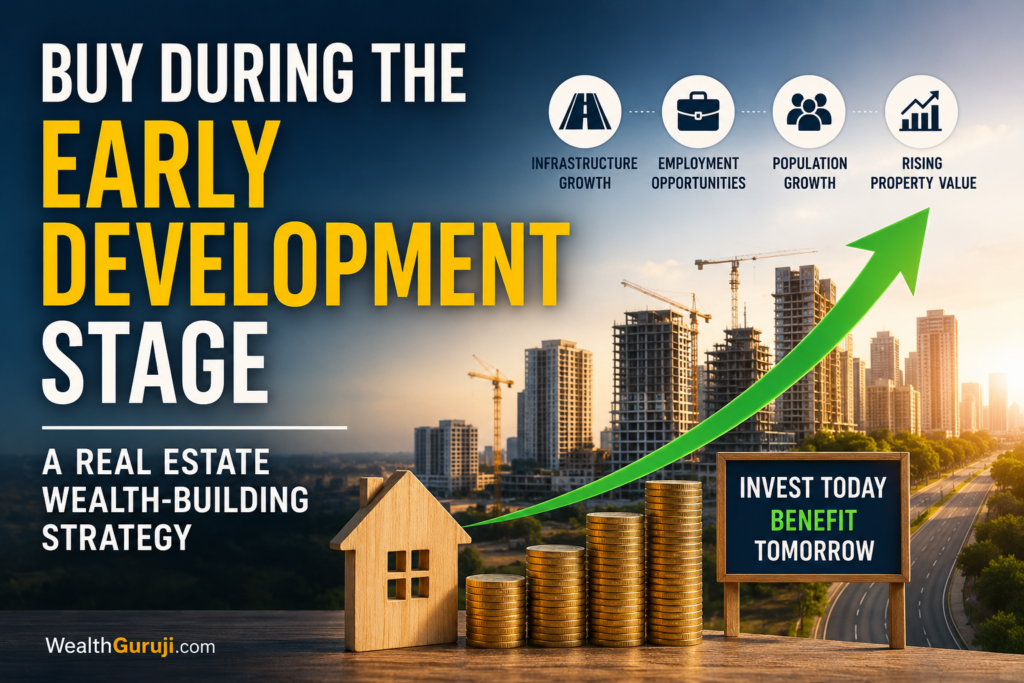
Buy During the Early Development Stage: A Real Estate Wealth-Building Strategy
Buying property at the right time can make a big difference to long-term real estate returns.
One strategy followed by many property investors is to buy during the early development stage of an area. The idea is to invest before major infrastructure, businesses and commercial activity are fully established.
At this stage, property prices may still be lower compared with mature locations. If the area develops as expected, better roads, public transport, offices, schools, hospitals, shopping centres and other facilities can increase demand for property.
This can create an opportunity for long-term capital appreciation.
However, early investment also comes with higher risk. Not every developing area becomes a successful real estate market.
The key is to identify real growth potential rather than simply buying a property because someone calls it an “upcoming location.”
What Is Early-Stage Real Estate Investment?
Early-stage real estate investment means buying property in an area that is still developing but shows signs of future growth.
You may find:
- New residential projects
- Roads under development
- Upcoming highways or metro connectivity
- New commercial projects
- IT parks or industrial areas
- New schools and hospitals
- Large land parcels being developed
- Growing population
- New shops and businesses
The area may not have all the facilities of an established locality.
That is where the opportunity can come from.
When a locality is already fully developed, property prices are usually higher because buyers are already paying for its connectivity, facilities and established demand.
An early investor is trying to enter before the area reaches that stage.
Why Do Investors Buy in Developing Areas?
The main reason is simple.
Buy at an earlier stage, hold for the long term, and benefit if demand increases as the area develops.
Suppose a property costs ₹50 lakh in a developing location today.
At present, the area may have limited infrastructure and fewer businesses. Over the next several years, roads may improve, new offices may open and more people may start living nearby.
If this development creates strong demand for homes, property prices may increase.
But there is no guarantee.
The development must actually happen, and it must create genuine demand.
Infrastructure Can Change a Real Estate Market
Infrastructure is one of the most important factors to watch when investing in a developing area.
A new road can reduce travel time.
A metro line can improve public transport.
A highway can connect the location with other parts of the city.
A new bridge can make an otherwise difficult location easier to reach.
These changes can make an area more attractive to homebuyers, tenants and businesses.
The development cycle often looks like this:
Better Infrastructure → Better Connectivity → More Businesses → More Jobs → More People → Higher Housing Demand
This is one of the reasons infrastructure development can have a major impact on real estate values.
However, investors should always check the actual status of an infrastructure project.
There is a big difference between a project that is:
- Being discussed
- Proposed
- Approved
- Funded
- Under construction
- Completed
Do not make a property investment based only on an unconfirmed future project.
Commercial Development Is Another Important Growth Driver
Residential development is only one part of a successful real estate market.
People usually want to live closer to their workplace and daily needs.
When offices, IT parks, industrial units, business parks or commercial centres come into an area, they can create employment.
Employees need homes.
They also need:
- Restaurants
- Grocery stores
- Schools
- Hospitals
- Banks
- Transport
- Entertainment
- Other daily services
This can gradually transform a developing locality into a complete neighbourhood.
For a property investor, the important question is not simply:
“What projects are coming here?”
Instead, ask:
“Will these projects create real jobs and real demand for housing?”
How to Identify a Potential Real Estate Growth Area
Finding the right developing location requires research.
Do not depend only on property advertisements or promises made by salespeople.
Look at the following factors.
1. Check Infrastructure Plans
Find out what major infrastructure is planned around the location.
Look for:
- Highways
- Ring roads
- Metro routes
- Railway connectivity
- Flyovers
- Bridges
- Road widening
- Public transport
- Water and sewage infrastructure
Try to verify important projects through reliable government or official sources.
A genuine infrastructure project can be a strong growth factor.
2. Look for Employment Opportunities
Employment is one of the strongest drivers of housing demand.
An area near a growing employment hub may attract both homebuyers and tenants.
Look for:
- IT parks
- Industrial areas
- Corporate offices
- Business parks
- Manufacturing units
- Logistics centres
A large employment base can create continuous demand for housing.
3. Study Population Growth
A growing population can be a positive sign for real estate.
Look at what is happening on the ground.
Are more families moving into the area?
Are new apartment buildings getting occupied?
Are shops opening?
Are schools and clinics starting?
Are restaurants and other businesses increasing?
These are practical signs that an area is becoming more active.
4. Study the Micro-Market
Do not evaluate a property only by looking at the city or the larger locality.
The exact location matters.
Two properties in the same broad area can have very different investment potential.
Check:
- Distance from major roads
- Public transport
- Access to employment hubs
- Nearby residential projects
- Existing development
- Future development
- Schools and colleges
- Hospitals
- Shopping facilities
- Water and electricity
- Traffic and road conditions
A good location within a developing area can perform very differently from a property located far away from the actual growth centre.
Early Development vs Established Location
Both strategies have advantages.
| Factor | Early Development Area | Established Area |
| Entry Price | Often lower | Usually higher |
| Infrastructure | Developing | Mostly available |
| Appreciation Potential | Potentially higher | Generally more moderate |
| Risk | Higher | Lower |
| Rental Demand | May take time | Usually stronger |
| Resale Liquidity | May be lower | Usually better |
| Holding Period | Usually longer | Can be shorter |
There is no single strategy that is best for every investor.
The right choice depends on your financial position, investment objective and ability to wait.
The First-Mover Advantage in Real Estate
One benefit of buying early is having more choices.
At an early stage, you may have a better selection of:
- Apartments
- Plots
- Project locations
- Floors
- Unit sizes
- Property types
As an area becomes popular, more buyers enter the market.
Demand can increase and the best properties may become more expensive.
This is where early investors may have an advantage.
But remember:
Being early is useful only when your assessment of the location is correct.
Buying early in the wrong location can result in a long wait with limited returns.
Early-Stage Property Investment Requires Patience
This strategy is generally not suitable for investors looking for quick profits.
Development takes time.
A road project may take several years.
A commercial project may take time to become operational.
Population growth may happen slowly.
Rental demand may increase only after employment opportunities become established.
For this reason, investors should be prepared to hold the property for several years.
Before buying, ask yourself:
“If the property does not appreciate quickly, can I comfortably continue holding it?”
If the answer is no, an early-development property may not be the right choice.
Risks of Buying Property in a Developing Area
Higher potential returns usually come with higher uncertainty.
Understanding the risks is extremely important.
Infrastructure Delays
A proposed road, metro line or highway may be delayed.
Timelines can change, and some projects may take much longer than expected.
Slow Development
Some areas remain “upcoming” for many years.
There may be attractive plans on paper, but actual development may be slow.
Always compare promises with what is actually happening on the ground.
Oversupply of Properties
If too many developers launch projects at the same time, supply can become higher than demand.
This can affect:
- Property prices
- Rental income
- Occupancy
- Resale demand
More construction does not automatically mean better investment potential.
Low Rental Demand
An early-stage location may not have enough tenants in the beginning.
If rental income is important to you, check the current rental market before investing.
Lower Liquidity
Selling property in a developing location may take longer than selling property in an established area.
If you need money quickly, this can become a problem.
Legal and Approval Risks
Property investment involves significant money.
Before buying, verify:
- Ownership and title
- Land records
- Required approvals
- Development permissions
- Building plans
- RERA registration, where applicable
- Existing loans or encumbrances
- Other relevant legal documents
For significant investments, professional legal due diligence is worth the cost.
How to Reduce the Risk
A good real estate investment is not based on hope.
It is based on research and proper due diligence.
Before investing in an early-development area, check:
Location
Is the property well connected to important parts of the city?
Infrastructure
Are major projects officially planned, approved or already under construction?
Employment
Are there genuine employment centres nearby?
Demand
Are people actually buying and occupying homes?
Rental Market
Are tenants available today, or is rental demand only a future expectation?
Developer
Does the developer have a reliable track record?
Legal Status
Are the land and project documents clear?
Price
Is the property reasonably priced compared with nearby locations?
Holding Capacity
Can you comfortably hold the property for several years?
These checks can help reduce the chances of making an investment based only on a future story.
Do Not Buy Just Because the Property Is Cheap
This is one of the most important lessons for property investors.
A property priced at ₹4,000 per sq. ft. is not automatically a better investment than one priced at ₹8,000 per sq. ft.
The cheaper property may be cheaper because:
- Connectivity is poor
- Demand is weak
- Infrastructure is limited
- Development is delayed
- Legal issues exist
- Supply is too high
- Construction quality is poor
Instead of asking:
“How cheap is this property?”
Ask:
“Why is it priced this way, and what can increase its demand in the future?”
That is a much better way to evaluate an investment.
A Simple Example of Early-Stage Real Estate Investment
Let’s take a simple example.
Rahul buys an apartment for ₹50 lakh in a developing area.
At the time of purchase:
- A major road project is under development.
- Several residential projects are being constructed.
- Commercial activity is limited.
- A large employment centre is expected nearby.
- Rental demand is still moderate.
Rahul does not expect immediate returns.
He plans to hold the property for several years.
Over time, suppose the following happens:
- Road connectivity improves.
- More businesses open.
- Employment increases.
- More families move into the area.
- Schools and hospitals open.
- Retail activity increases.
- Rental demand becomes stronger.
If these changes create genuine housing demand, the property may appreciate.
But suppose the infrastructure project is delayed and employment growth does not happen.
In that situation, property appreciation could be much slower.
This is why early-stage real estate investment should always be based on research rather than speculation.
Who Should Consider This Real Estate Strategy?
Buying during the early development stage may suit investors who:
- Have a long-term investment horizon
- Can accept higher risk
- Do not require immediate rental income
- Have stable finances
- Can handle a longer holding period
- Are willing to research the location
- Do not depend on quick appreciation
It may not be suitable for investors who:
- Need immediate liquidity
- Depend heavily on rental income
- Cannot handle delays
- Have limited financial reserves
- Need guaranteed returns
- Are investing based on one future infrastructure project
Common Mistakes Investors Should Avoid
1. Assuming Every Upcoming Area Will Become a Boom Area
The word “upcoming” is often used in real estate marketing.
Do your own research before accepting the claim.
2. Believing Guaranteed Appreciation Promises
Nobody can guarantee that a property will double in value within a particular period.
Real estate prices depend on many factors.
3. Depending on One Infrastructure Project
If your entire investment depends on a single metro line, highway or road project, your risk is much higher.
Look for multiple growth drivers.
4. Ignoring Current Demand
Future potential is important, but current demand also matters.
Study actual occupancy, rentals and property transactions wherever reliable information is available.
5. Ignoring Legal Due Diligence
A property with excellent appreciation potential is not worth the risk if its legal or ownership position is unclear.
6. Taking Too Much Debt
A developing location may take years to appreciate.
A large loan can put unnecessary pressure on your finances during the waiting period.
How This Strategy Can Help Build Real Estate Wealth
Real estate wealth is usually built over time.
An investor can combine early-stage investing with a long-term strategy such as:
Buy → Hold → Area Develops → Demand Increases → Potential Appreciation → Build the Next Asset
Over time, an investor may build a portfolio of properties across different locations and property types.
However, diversification is important.
Do not put all your money into one developing location simply because you believe it will become the next big real estate destination.
A balanced approach can help manage risk.
The Most Important Rule: Buy the Growth, Not the Story
There will always be new areas described as the “next big destination.”
Some will succeed.
Some will take much longer than expected.
Others may never develop as predicted.
The experienced approach is to look beyond the sales pitch.
Ask:
- What is changing today?
- What infrastructure is actually being built?
- Where will the jobs come from?
- Who will live here?
- Is there real demand?
- Is the price reasonable?
- Can I hold the property for the long term?
These questions can help you identify whether you are buying a genuine growth opportunity or simply buying a promise about the future.
Final Thoughts
Buying during the early development stage can be a powerful real estate wealth-building strategy, but it requires patience, research and careful risk management.
The biggest opportunity comes when an area has genuine reasons to grow.
Better connectivity, new employment opportunities, commercial development, population growth and improved social infrastructure can all contribute to increasing property demand.
At the same time, investors should remember that future development is never guaranteed.
The best strategy is not to simply find the cheapest property in an upcoming area.
It is to find a property where:
Good Location + Real Infrastructure + Employment Growth + Rising Demand + Reasonable Price = Stronger Long-Term Investment Potential
If you can identify these factors and comfortably hold the property for the long term, buying early in a developing area can become an important part of your overall real estate wealth-building strategy.
Frequently Asked Questions About Early-Stage Real Estate Investment
1. What is early-stage real estate investment?
Early-stage real estate investment means buying property in a developing area before it becomes fully established. The investor expects future infrastructure, employment and population growth to increase property demand.
2. Is buying property in a developing area a good investment?
It can be a good investment when the area has genuine growth drivers. However, developing locations also carry higher risks than established markets.
3. Why can infrastructure increase property prices?
Better infrastructure can improve connectivity and reduce travel time. This can attract businesses, employees, residents and other services, potentially increasing demand for nearby properties.
4. What infrastructure should property investors look for?
Investors can study highways, ring roads, metro routes, railway connectivity, bridges, public transport, water supply, sewage systems and other major infrastructure projects.
5. Should I buy property before a metro or highway is completed?
Early investment can provide an opportunity, but investors should carefully verify the status of the project. Do not rely only on an unconfirmed proposal.
6. What is the biggest risk of investing in an upcoming area?
The expected development may take longer than planned or may not happen at the expected scale. This can result in slower property appreciation and lower rental demand.
7. How long should I hold an early-stage property?
There is no fixed holding period. However, investors should generally be prepared for a longer holding period because infrastructure and demand can take years to develop.
8. Is an upcoming area better than an established locality?
Not necessarily. Upcoming areas can offer higher appreciation potential but also carry higher risk. Established locations may offer better rental demand, liquidity and existing infrastructure.
9. How can I identify a good developing location?
Study infrastructure, employment opportunities, population growth, connectivity, commercial activity, residential demand, developer activity and property prices.
10. Is property appreciation guaranteed in a developing area?
No. Real estate appreciation is never guaranteed. Market conditions, supply and demand, interest rates, economic growth, infrastructure and many other factors can affect property values.
Key Takeaway
Do not buy a property simply because someone says an area will develop.
Buy when you can identify real reasons for future demand, the price makes financial sense, the property passes proper due diligence, and you have the patience to wait for the development cycle.
That is the difference between buying an upcoming property and following a disciplined real estate wealth-building strategy.